///_Articles
How to Start Affiliate Marketing With No Money: A Step-by-Step Guide

Learning how to start affiliate marketing with no money is realistic, because the setup costs time and effort rather than cash. Joining an affiliate program is free in most cases, and the social media platforms where beginners find a first audience, including TikTok, YouTube and Instagram, do not charge for an account. What the work demands is choosing a topic, learning what people want to know and publishing content for weeks before the first commission arrives.
This guide to affiliate marketing follows seven steps, from picking a niche to tracking results. It then covers the best free traffic channels, free tools, common mistakes and a realistic timeline, and it ends with a plan you can copy.
One caveat applies throughout. In affiliate marketing, free does not mean unlimited, and many tools and platforms change their free plans, so check the current terms before you build a routine around any of them.
Can You Start Affiliate Marketing With No Money?
Yes. Affiliate marketing pays a commission when someone buys or signs up through your link, and you do not need to own a product, a store or inventory to take part. Most affiliate programs and affiliate networks accept new members without a fee, though a few ask for a small refundable deposit.
Starting affiliate marketing costs very little, but the first sales take time. A new account has no audience, a new website has no search visibility and a new affiliate has no track record with the program, so the early weeks usually produce clicks and learning rather than income.
What “No Money” Really Means: Time, Skills, and Free Tools
A zero-budget start in affiliate marketing replaces cash with other resources:
- Time: creating and promoting content takes hours every week, and results arrive slowly.
- Skills: writing, filming, editing or simply explaining a product clearly. These improve with practice.
- Free tools: research, design, email and tracking tools that offer a free plan.
Some costs can appear later, such as a domain name, a paid email plan or a course. None of them is required at the start, and it is better to let early results decide whether any of them is worth buying.
How Affiliate Marketing Works
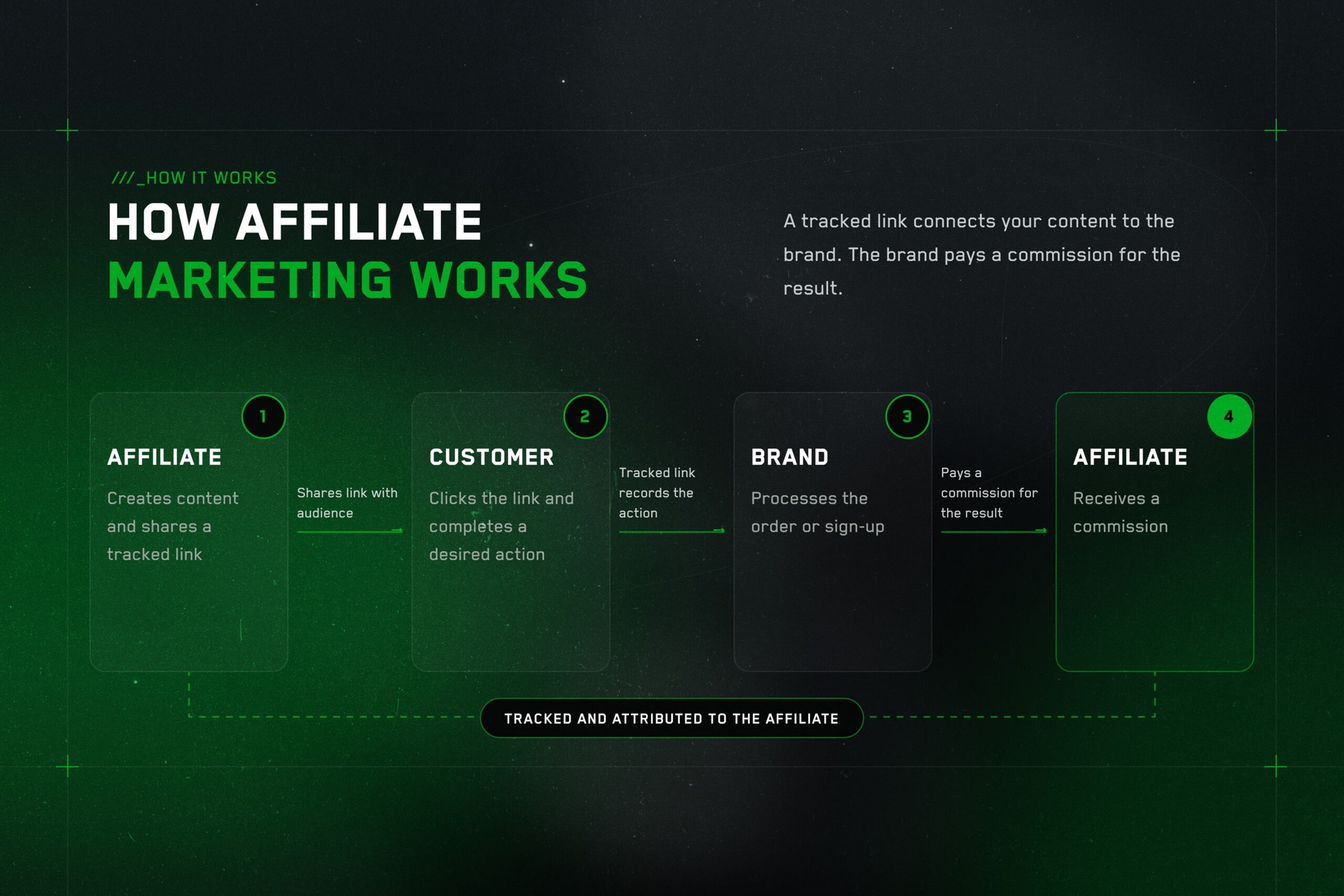
Affiliate marketing is a performance-based arrangement. A brand pays an affiliate a commission when a referred visitor completes a defined action, usually a purchase or a sign-up. The affiliate recommends products or services, and the brand pays only for results.
Affiliate marketing attracts beginners because the brand handles the product, payment processing and customer support, while the affiliate handles the promotion. That split removes the biggest upfront costs of selling, which are inventory and a store.
The Roles of the Brand, Affiliate, Customer, Link, and Commission
The brand owns the offer and sets the terms: what counts as a sale, how long the tracking window lasts and which commission rates apply. Commission rates vary by program and by category, so they need to be checked rather than assumed.
The affiliate is the publisher who earns the commission. Affiliate marketers create reviews, tutorials, comparisons and recommendations that help a customer decide.
The customer is the person who clicks the link and completes the action. The link carries a tracking ID that tells the brand which affiliate sent the visit, and the commission is the payment the brand makes once the action is confirmed.
The sequence is short:
- The affiliate joins a program and receives a unique link.
- The affiliate publishes content that includes the link.
- A customer clicks the link and the visit is tracked.
- The customer buys or signs up.
- The brand confirms the action and pays the commission at the end of the payout period.
Because terms differ between programs, Step 2 below compares them on a checklist.
How and When Affiliates Get Paid
Commission is paid after the brand confirms the action, and that can happen well after the click. Most brands keep a commission in a pending state until the return or cancellation period ends, and only then move it to the approved balance. Payouts are usually released once the balance passes a minimum threshold, on a monthly or similar schedule, through methods such as bank transfer or PayPal.
Reversals happen. If a customer refunds a purchase or a lead is rejected, the commission is removed. That is why the quality of the products you recommend matters, and why the amount shown as pending is not guaranteed income.
Earnings from affiliate marketing are generally taxable income, and the rules differ by country. Keep records of every payment from the start and check the local requirements.
Start Affiliate Marketing With No Money: Step by Step
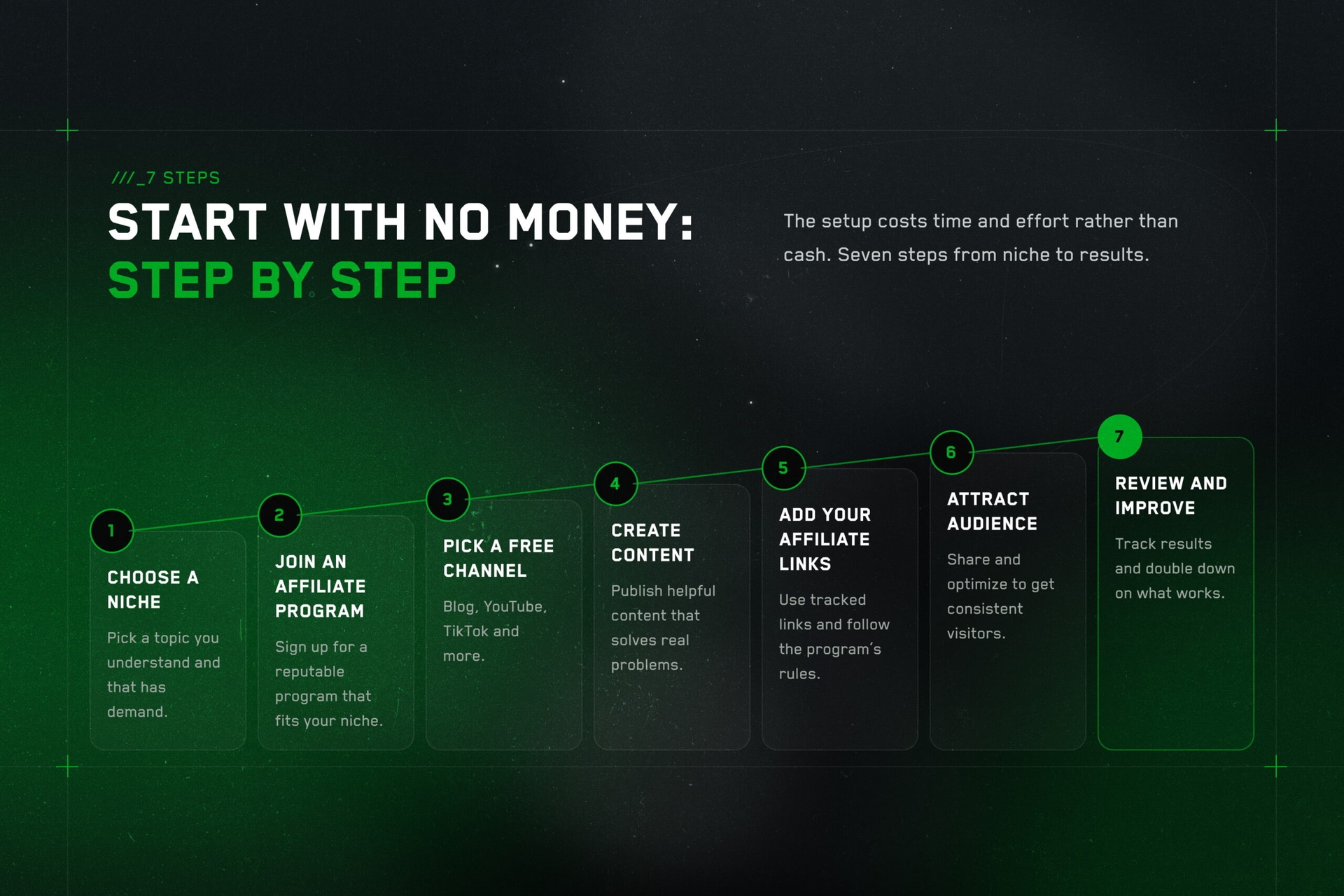
The seven steps below follow the order in which affiliate marketing decisions depend on each other. The niche determines which programs make sense, the program determines which products you can recommend, and the channel determines what content you make.
Step 1: Choose and Validate a Profitable Niche
Choosing a niche is the decision that shapes everything after it, so it deserves more time than the other steps. A niche is a specific topic with a specific audience, such as budget travel for families or home workouts for beginners. Broad topics like fitness attract heavy competition, while very narrow ones can make it hard to find enough people.
Start with what you already know or are willing to learn. Your interest matters because you will publish about the topic for months, and your experience helps you explain products with details that generic sites lack.
Describe your audience in one sentence before you go further: who they are, what problem they are trying to solve and what they have already tried. That description guides which products you recommend, which questions your content answers and which channels you use. An audience that stays vague produces content that stays vague, and in affiliate marketing a specific recommendation is easier to act on than a general one.
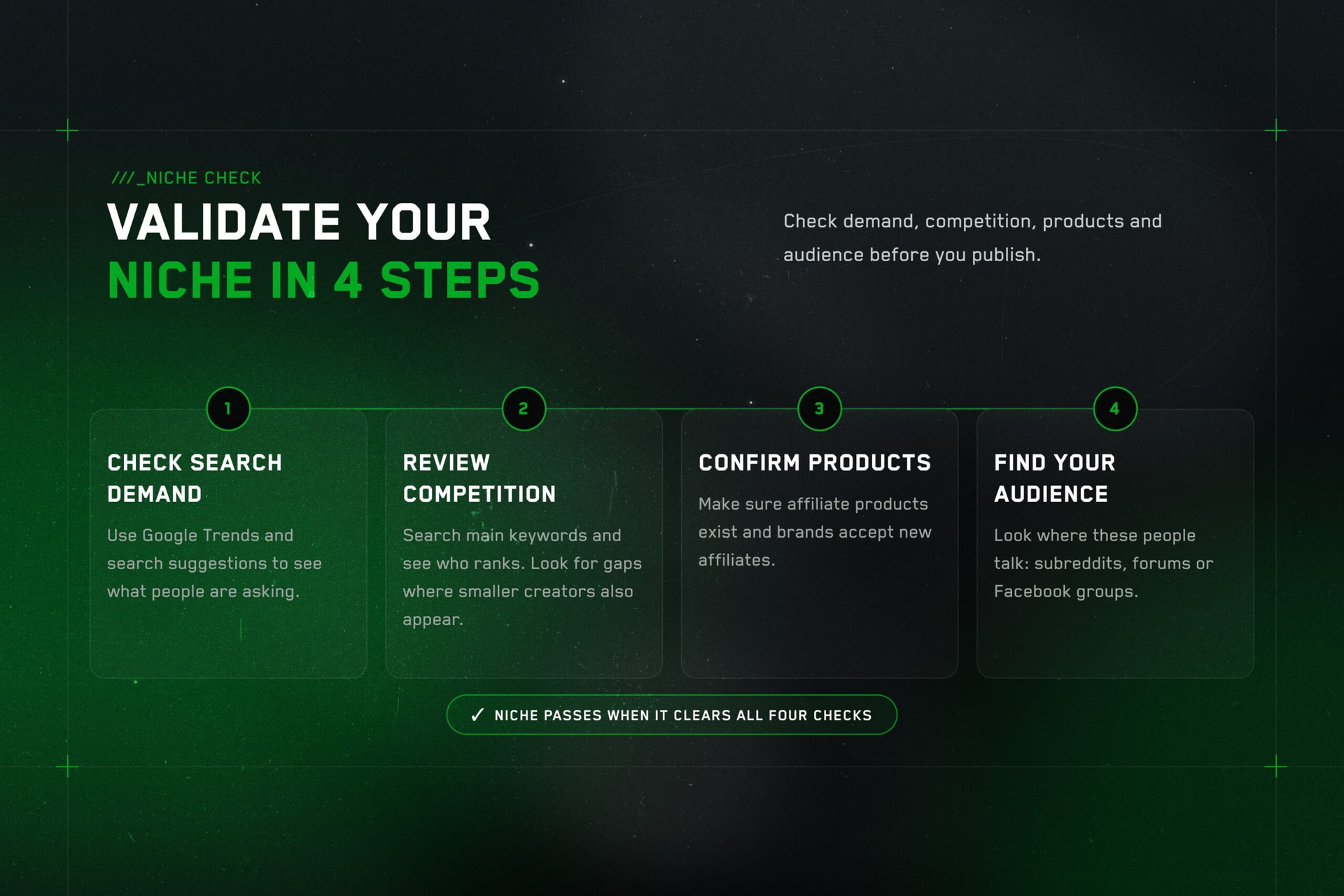
Then validate the niche before committing. Four quick checks need only free tools:
- Search demand: look the topic up in Google Trends and in search suggestions to see whether people ask questions about it.
- Competition: search the main keywords and check who ranks, and whether small creators appear on the first page.
- Products: confirm that affiliate products exist for the topic and that brands accept new affiliates.
- Audience: find where those people talk, such as subreddits, forums or Facebook Groups.
A niche passes when it clears all four checks and you can imagine writing fifty pieces about it. A topic that fails one is easier to replace early than to abandon after three months.
Some niches, including finance, health and iGaming, carry extra rules on what you can claim and where you can advertise. They can still work, but read the program terms and the platform policies first. In iGaming, for example, advertising platforms such as TikTok and Google restrict gambling ads and require licensing or certification, so confirm a platform’s current gambling policy before you choose a channel.
Step 2: Find and Compare Affiliate Programs or Networks
In affiliate marketing, programs are run directly by a brand, while affiliate networks collect many offers in one dashboard. You can usually find a direct program by searching the brand name plus “affiliate program” or by checking the website footer. Networks such as ClickBank, Awin, CJ and Rakuten Advertising give you access to many advertisers from one account, and some offers inside them need separate approval from the advertiser. Awin, for example, asks for a small refundable deposit at sign-up, which matters if your budget is exactly zero.
ClickBank lists digital and physical offers in a public marketplace, which makes it easy to see what is available before you apply. Amazon Associates covers a very wide range of items, and its commission rates are set by product category.
Compare programs on a short checklist:
- Commission: the percentage or fixed amount per sale, and whether it recurs.
- Cookie duration: how long a click stays valid, which affects credit when customers buy later.
- Payout rules: minimum threshold, payment methods and schedule.
- Earnings per click (EPC): when a network shows it, it gives a rough sense of how well other affiliates convert.
- Terms: allowed traffic types, restricted keywords and required disclosures.
Look at the products behind the program as well as the payout. Choose products you would recommend without a commission, read their reviews, check the refund policy and find out whether they are physical or digital. Digital products often carry higher commission percentages than physical ones, and the right mix depends on your audience. A high commission on weak products rarely lasts, because refunds and complaints follow.
Apply to one or two programs at first, and add more only after you have published. Some programs review an application by looking at your website or social media profile, so a few published posts help.
Step 3: Select One Primary Free Traffic Source
A free traffic source is any channel that sends visitors without ad spend, such as search, video, social media feeds, email and communities. Beginners in affiliate marketing often try five sources at once and end up with thin content on all of them. Pick one primary channel and give it a fixed period before judging it.
Match the channel to your strengths and your niche. Writing fits blogs and search, speaking on camera fits YouTube and TikTok, visual products fit Instagram and Pinterest, and conversation fits communities. The section on the best free traffic channels below compares them.
Organic traffic costs time and builds slowly, but it keeps working after a post is published. That makes it the sensible default when the budget is zero.
Step 4: Create Useful Content That Builds Trust
Content is what turns a link into a recommendation. Content creation for affiliate marketing works best when it answers a question the audience in your niche already has: how to choose a product, how it compares with another one, how to use it or what problem it solves.
Formats that work include balanced reviews, side-by-side comparisons, tutorials, lists and case studies. Say what a product does well and where it falls short, because readers notice when everything gets praise.
Use the product before reviewing it when possible, or at least try the free trial, the demo or the documentation. Original screenshots, notes and specific details separate useful content from copied descriptions.
Keyword research costs nothing at a basic level. Type a topic into Google and read the autocomplete suggestions, the “People also ask” box and the related searches at the bottom of the page.
Match each piece to where the audience is in the decision. Someone who has just noticed a problem wants an explanation, so a guide or a list of options fits. Someone comparing options wants a side-by-side review, and someone ready to buy wants specifics such as pricing, setup and refund terms. Covering each stage with a different piece gives affiliate marketing content more chances to meet readers when they are ready to act, and it lets you link to different products in each.
Step 5: Add Affiliate Links, Calls to Action, and Disclosures
Place affiliate links where the audience is already deciding: inside a comparison table, next to the products you mention or after a section that answers the question. A link dropped into an unrelated paragraph is less likely to be clicked and looks like an advertisement.
Recommend fewer products, in more depth. A page that lists twenty products with one line each gives the reader no reason to trust any of them, while a page that explains three and says who each one suits is easier to act on. Check that every product you link to is still available and that the link points to the right page.
A call to action should say what happens next, such as “see current pricing” or “check the free trial”, instead of a vague “click here”.
In most markets, disclosure is required. In the United States, the Federal Trade Commission expects a clear statement when you earn from a link, and many other countries have similar rules. Put the disclosure close to the link in plain words, such as “I earn a commission if you buy through this link”, and use each platform’s own labelling tools where they exist.
Programs also restrict how links can be used. Some prohibit links in email or on certain platforms, so read the terms before you add links to a newsletter, a video description or a social media bio.
Step 6: Grow and Engage an Audience
An audience is the group of people who come back to your content. Growing one is slower than publishing a single post, and it depends on consistency.
Publish on a schedule you can keep, answer comments and questions, and ask what people want to see next. Their replies work as free market research for your niche.
Social media gives faster feedback than search, since comments, saves and shares show within hours which topics interest the audience. Use that feedback to decide what to cover on slower channels such as a blog.
Start an email list early. An email list belongs to you, while social followers depend on platform algorithms that you do not control. A simple lead magnet, such as a checklist or template related to your topic, gives people a reason to subscribe, and most email platforms offer free plans for small lists.
Step 7: Track Results and Improve
In affiliate marketing, tracking shows which content earns and which does not. Without it, clicks and sales blur together and effort goes to the wrong places.
Four numbers cover the basics:
- Clicks per link: how many people moved from your content to the offer.
- Conversion rate: the share of those clicks that ended in a sale or sign-up.
- Earnings per click: commission divided by clicks, which lets you compare content of different sizes.
- Revenue by channel: the total each channel contributed.
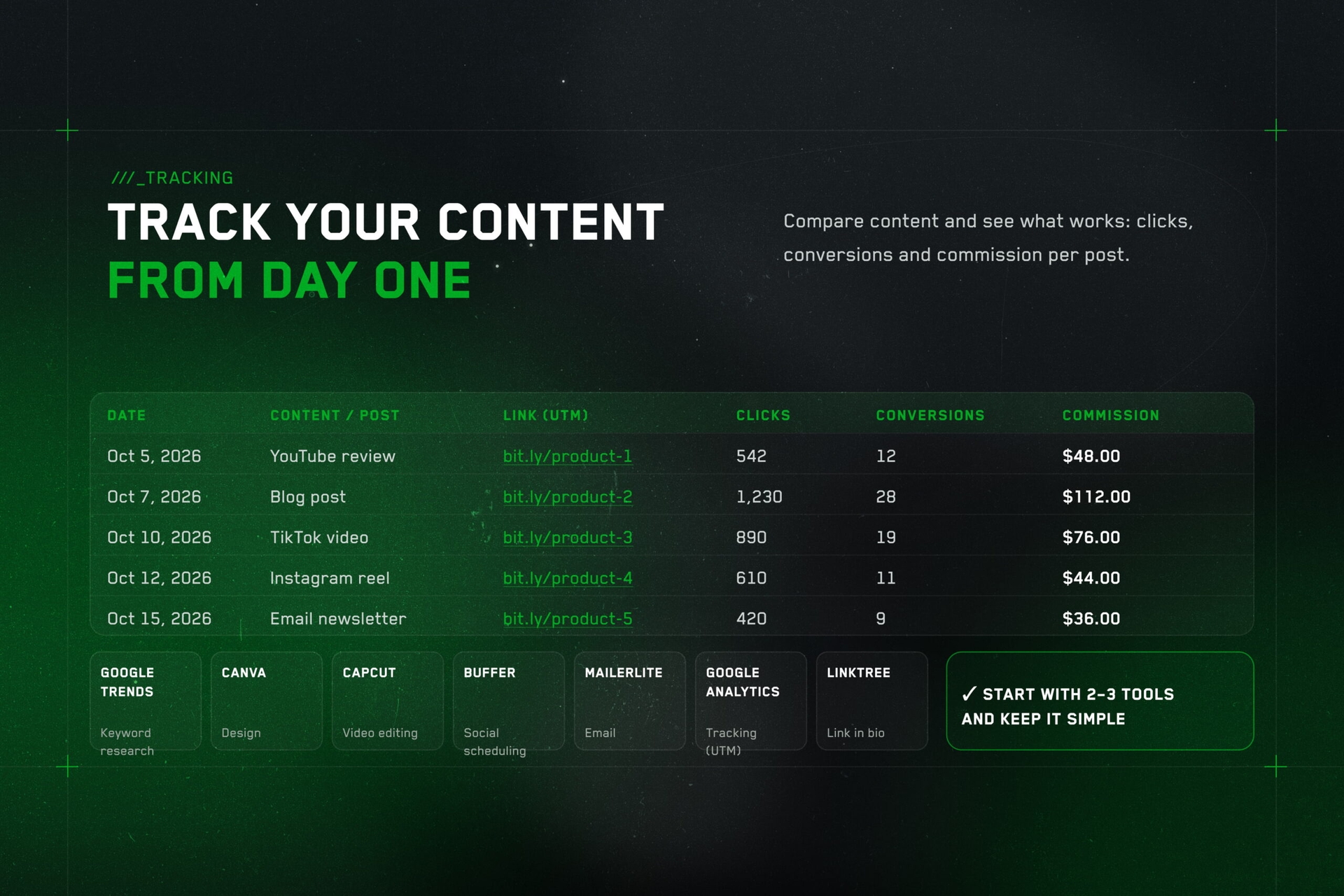
Free options cover most of this. The program’s own dashboard shows clicks and commissions, UTM tags separate visits from different channels in Google Analytics, and a free link shortener such as Bitly shows basic click counts.
Review the data on a fixed schedule, such as every two weeks. Update the content that gets clicks but few sales, publish more of what earns and drop formats that take time and produce nothing.
Best Free Traffic Channels for Beginners
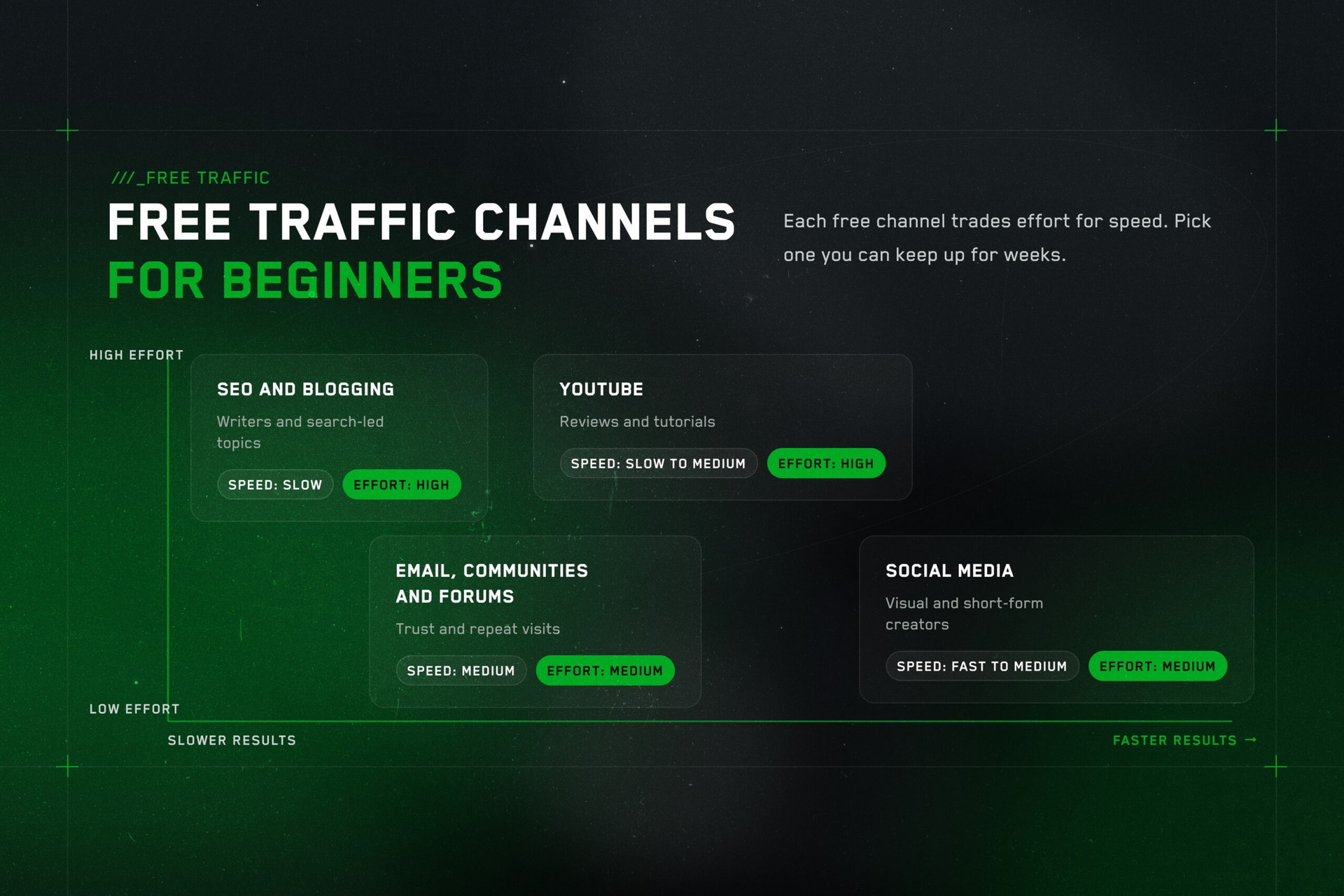
Each affiliate marketing channel suits a different kind of creator and a different audience. The table gives a quick comparison before the sections below go into detail. The ratings are general guidelines, since niche, competition and consistency change the outcome.
| Channel | Best for | Speed | Effort |
| Social media | Visual and short-form creators | Fast to medium | Medium |
| YouTube | Reviews and tutorials | Slow to medium | High |
| SEO and blogging | Writers and search-led topics | Slow | High |
| Email, communities and forums | Trust and repeat visits | Medium | Medium |
Social Media: TikTok, Instagram, Facebook, and Pinterest
Social media is one of the quicker ways for a new account to reach an audience that does not follow it yet, because feeds show content to strangers. It works best for products that are easy to show or explain in under a minute.
Social media works for affiliate marketing when the content has a purpose beyond the link. Teaching or demonstrating something brings people in, and the recommendation follows. Posts that contain only a link and a slogan give viewers little reason to click.
Pick the social media platform where people in your niche already spend time, and check that it allows affiliate links in the places you plan to use them.
TikTok favors short videos with a clear hook. Product demos, quick comparisons and “what I use” clips fit the format. Where TikTok allows a clickable profile link, mention it in the video. The platform limits that feature to accounts that meet its requirements, and for personal accounts that has included a follower threshold, so a new account may have to point viewers to another channel at first.
Instagram combines Reels, which help discovery, with stories and a link in bio for the click. Visual topics such as fitness, beauty, travel and home decor fit it well.
Facebook Groups suit community-driven topics, since members ask for recommendations. Pinterest works as a visual search engine, and a pin can keep appearing in results long after it is published. Check each platform’s rules on affiliate links before you post.
Social media posts have short lifespans, so plan to turn one idea into several pieces instead of writing something new every day.
YouTube and Other Video Platforms
YouTube is both a video platform and a search engine, which gives affiliate marketing tutorials and reviews a long life. A video titled with a question people search for can keep bringing viewers, and the description is the natural place for affiliate links. New channels may need to complete YouTube’s verification before links in long-form descriptions become clickable.
You need no studio. A phone, natural light and a clear voice are enough, and free editors such as CapCut cover the basics. Show the products in use, state the disclosure on camera and in the description, and keep the first minute focused on the answer.
TikTok and Instagram Reels can send viewers to a longer YouTube video, so short and long formats can support each other.
SEO, Blogging, and Search-Led Content
A blog for affiliate marketing is slow to start and strong over time. Search-led content targets what people type into Google, and a page that ranks can send organic traffic for months without extra spend.
A custom domain and hosting usually cost money, so some beginners start on a free blogging or newsletter platform and move later. Check the program terms first, since a few brands require a website the affiliate controls.
Write for one search intent per page: a comparison, a how-to guide or a review. Use clear headings, answer the question near the top and link to the products where a reader would expect it.
Email Lists, Communities, and Forums
Email, communities and forums reward patience and usefulness, qualities that matter in affiliate marketing. An email list lets you reach your audience directly each week, while Reddit, Quora, Discord servers and niche forums bring in readers who ask for recommendations.
Take part before you promote. Answer questions in full, follow each community’s self-promotion rules and mention an affiliate relationship when you recommend something. Many communities remove posts that only drop links.
These channels work best in support of a primary channel: a short forum answer can point to a detailed guide, and a newsletter can bring readers back to new posts.
Free Tools for Starting Affiliate Marketing
Free tools for affiliate marketing cover research, content, email and tracking. Free plans have limits that change, so confirm the current terms before building a workflow around one.
| Task | Free options |
| Topic and keyword research | Google Trends, Google autocomplete, Google Search Console |
| Design | Canva free plan |
| Video editing | CapCut |
| Social media scheduling | Buffer and Metricool free plans |
| MailerLite, Mailchimp or Kit free plans | |
| Link tracking | UTM tags with Google Analytics, Bitly free tier |
| Link in bio | Taplink or Linktree free plans |
Start with two or three tools, since each additional tool adds setup time. Affiliate marketers who track from the first week can compare content over time, and a spreadsheet that lists each post, its link and its results already covers the basics.
Common Beginner Mistakes to Avoid
Most early problems in affiliate marketing come from a short list of habits:
- Choosing a niche for commission size alone, without interest or knowledge.
- Joining many programs before publishing anything.
- Spreading content across several channels with thin results on each.
- Promoting products without testing them or reading the program terms.
- Skipping or hiding the disclosure.
- Judging results after a few weeks.
- Not tracking where clicks come from.
- Posting only links, with nothing useful for the audience.
The mistakes about niche and program choice cost the most, because they affect everything published afterward.
How Long Does It Take to Make Money With Affiliate Marketing?
There is no fixed answer. People ask how soon they can make money from affiliate marketing, and the time to a first commission depends on the channel, the niche, how often you publish and how well the content matches what people are searching for or watching.
Social media channels can send first clicks within days, and a first commission may arrive within weeks or months if the content is relevant. Blogs and YouTube usually need longer, since search engines need time to find, index and rank new pages.
Milestones are a more useful measure than dates:
- Setup: niche chosen, program joined, first channel created.
- First content: ten to fifteen pieces published with tracked links.
- First data: clicks recorded on most links, enough to see which content works.
- First commission: often small, but it shows the whole path from content to payment works.
- Reinvestment: update the best pieces and add a supporting channel.
Meaningful income takes longer than a first commission. Treat the first three months as a testing period and set goals for publishing and learning rather than income. Income claims that give no timeline or method deserve caution.
Frequently Asked Questions
Do You Need a Website to Start Affiliate Marketing?
No. You can start with a social media profile, a YouTube channel or an email list. A website helps in the long run because you control it, it can rank in search and you can add pages freely. Many brands accept applications based on a social profile, so check the terms of each one.
Which Affiliate Programs Are Best for Beginners?
The best program matches your niche, accepts new affiliates and has clear terms. Beginners can start with a network such as ClickBank, Awin or CJ, or with a direct program from a brand whose products they already use, and should check each sign-up page for fees. Compare commission levels, cookie duration and payout rules instead of choosing by the headline percentage alone.
How Can You Promote Affiliate Products for Free?
In affiliate marketing, you can promote products for free through content on platforms that do not charge for an account: videos, posts, articles, newsletter issues and community answers. Pick one channel, publish steadily, add a disclosure next to each link and measure which pieces earn.
A Practical Zero-Budget Action Plan
The plan below turns the seven steps of affiliate marketing into a schedule.
- Week 1: choose a niche using the four checks, shortlist two programs and read their terms.
- Week 2: apply to one or two programs, set up the primary channel and write a disclosure line.
- Weeks 3 and 4: publish the first pieces with tracked links and start an email list on a free plan.
- Month 2: publish on a steady schedule, answer every comment and add the first supporting channel.
- Month 3: review clicks and conversions by channel, update the weakest pieces and decide what to keep.
Starting affiliate marketing without a budget is a time investment with a clear structure: one niche, one program, one primary channel and regular tracking. The first results come from steady publishing, and the data shows what to do next.
If the iGaming niche is on your shortlist, Growe Partners works across casino and betting products, with conditions defined for specific offers. Affiliates can review current requirements at Growe Partners and check the rules for their channels and countries before they start.