


///_Articles
Affiliate Marketing Funnels: How They Work and What to Track

A campaign can generate 5,000 visits and still underperform one with half the audience. The difference often appears after the first click: fewer users continue to the offer, completed actions fail to qualify, or the commission model changes the commercial value of the result.
Looking only at visits or final sales does not show where that difference comes from. For affiliates, the more useful question is which stage of affiliate marketing changed and how that affected conversion.
An affiliate marketing funnel separates this path into measurable stages, from first contact and affiliate content to the tracked action, qualification, and commission. It helps show where users drop off, which stages affiliates control, and which depend on the advertiser or partnership conditions.
Key Takeaways
- An affiliate sales funnel includes stages that affiliates control and stages that the advertiser controls.
- A completed action and a qualified action are not the same thing, and tracking them separately matters.
- Similar customer paths can produce different sales results under different partnership conditions.
- Building the path starts with the audience and offer, not with content production.
- Testing one stage at a time makes it easier to explain changes in marketing results.
What Is an Affiliate Marketing Funnel?
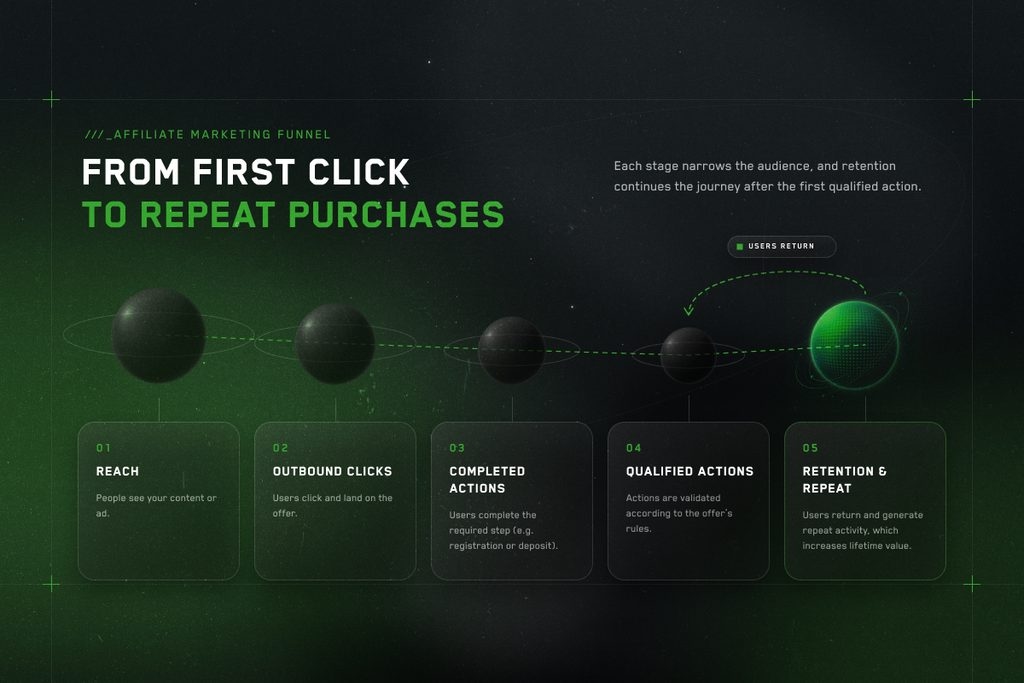
A traditional marketing funnel can cover a brand’s entire customer journey, from initial awareness to repeat purchase. An affiliate marketing funnel covers a narrower part of that journey. It starts when a visitor encounters affiliate content or promotion and continues until the affiliate program checks the tracked action against its qualification rules.
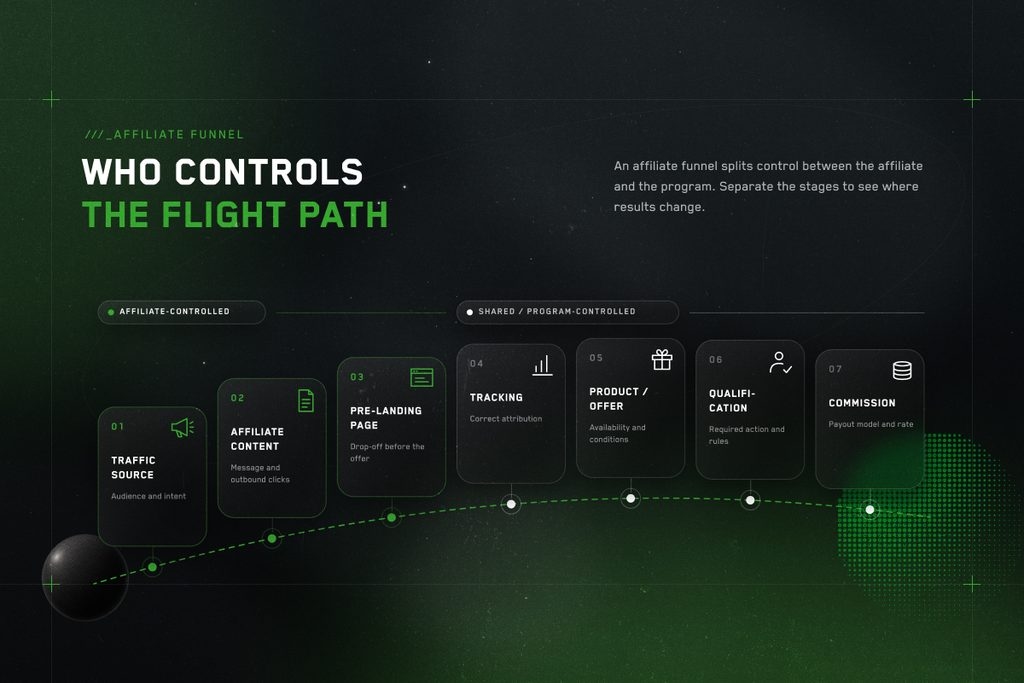
Unlike a traditional marketing funnel, an affiliate marketing funnel splits control between the affiliate and the program.
Funnel ElementWho Controls ItWhat to CheckTraffic sourceAffiliateAudience and intentAffiliate contentAffiliateMessage and outbound clicksPre-landing pageAffiliateDrop-off before the offerProduct / offerAdvertiserAvailability and conditionsTrackingAdvertiser + affiliate setupCorrect attributionQualificationAffiliate programRequired action and rulesCommissionAffiliate programPayout model and rateAffiliates can control acquisition channels, content, and the path to the offer, while other stages depend on the advertiser or partnership terms. Separating these responsibilities makes it easier to identify which part of the customer journey needs attention when results change.
How an Affiliate Sales Funnel Works
An affiliate sales funnel moves a visitor through several connected stages. Each stage affects whether the visitor continues and eventually completes a qualified action.
Reach and First Contact
This is where a visitor first encounters the offer through search, social media, email, a review site, or another channel.
Context matters as much as volume. Someone arriving through a comparison search has different expectations from someone who discovers a product while scrolling through social media.
A channel can generate plenty of visitors and still produce weak downstream results if the audience does not match the offer. For affiliates, the first useful comparison is not simply visitor volume, but how those users continue through the next stages.
Affiliate Content and Pre-Sell
Between first contact and the click to the offer, affiliates may use product reviews, comparisons, or educational content to give visitors more information before they continue.
Testimonials and third-party reviews can provide social proof. The goal is to connect the user’s initial interest with the product or offer they see at the next stage. In this part of affiliate marketing, the content should answer the questions that brought the user to the page rather than simply repeat the offer.
Landing Pages and the Offer
What a visitor sees after the click should match the message that brought them there.
If the product, offer, or framing changes between the affiliate content and the landing pages, users may leave before completing the next action. A consistent message also makes it easier to identify problems elsewhere in the funnel.
Tracked Action and Qualification
The visitor completes the action defined by the offer, such as a signup, deposit, or purchase. Tracking connects that action to the affiliate. The affiliate program’s qualification rules then determine whether it counts as a qualified action.
A completed action and a qualified action are not always the same thing. A visitor may complete the required step, but the action still needs to meet the program’s conditions.
For funnel analysis, affiliates should track these two stages separately. Otherwise, a drop in qualification can look like a traffic or landing page problem.
This distinction also matters when measuring conversion. A campaign may maintain the same number of completed actions while producing fewer qualified ones. Looking at both stages separately shows whether the change happened before or after the required action.
Commission
The path does not end at qualification. Commission rates and the payment model determine the commercial value of a qualified action.
Two campaigns with similar visitor volume and qualification results can produce different revenue under different program conditions.
Consider a campaign that brings 5,000 visitors to affiliate content. If 1,000 continue to the offer, the outbound click rate is 20%. If 150 complete the required action and 90 meet the offer’s qualification rules, the qualification rate is 60%.
These numbers make the drop-off visible. Losing users between the content and the offer points to a different problem from generating many completed actions but only a small number of qualified ones.

Retention and Repeat Purchases
Qualification is not always the last stage that matters. After the first qualified action, a user may return, buy again or continue using the service. A first-time buyer and a returning customer can look identical at the qualification stage but contribute differently to customer value over time.
Whether retention affects affiliate revenue depends on the payment model. A fixed payout for a qualified action does not change with later customer activity, while a revenue-based model can continue to reflect it. Where retention is relevant, returning users and repeat activity should therefore be measured separately from the initial qualified action.
How to Build an Affiliate Sales Funnel
Building the path starts with defining the audience, offer, and expected customer journey before producing content around them. This gives affiliates a clear connection between the marketing channel, the offer, and the action they need to measure.
- Define the target audience and acquisition channel. Decide who the content is for, what intent brings those users in, and where the first interaction will happen.
- Choose the affiliate offer and confirm its conditions. Check what counts as a qualified action, which markets are available, and which payment and attribution terms apply.
- Plan the path from content to action. Define what a visitor sees at each step, from the first interaction through to the offer.
- Set up tracking for each stage. Track reach, outbound clicks, completed actions, and qualification separately so you can connect each change to a specific part of the funnel.

Affiliate Funnel Examples
For affiliates, the starting intent changes how each marketing channel fits into the customer path.
A content or SEO path can start with a search query, continue through a review or comparison page, and lead to the offer and tracked action. Search intent matters because users arriving from informational and comparison queries can have different expectations. For affiliate marketing, this makes the relationship between the query, content, and offer especially important.
Social media marketing can start with content discovered in a feed, followed by a profile link or landing page and then the offer. Unlike search, the first interaction may happen without an active product query, so the content needs to provide enough context for the next step.
Affiliates using email start with an existing subscriber and can lead that user directly to an offer or through another content page first. Because the audience has already interacted with the publisher, affiliates should measure email traffic separately from first-time visitors coming from search or social media.
How to Measure Affiliate Marketing Results
A few core metrics show what happens at each stage of the affiliate sales funnel.
StageWhat to TrackReachVisits / clicksAffiliate contentOutbound click rateLanding pagesConversion to actionActionCompleted actionsQualificationQualification rateCommercial resultCost / revenue / commissionRead these metrics in sequence rather than separately. A change in conversion should first be connected to the stage where it happened.
If reach stays stable but outbound clicks fall, start with the affiliate content. If outbound clicks remain stable but completed actions fall, check the post-click experience and offer. If completed actions remain stable but qualification falls, look at the qualification stage.
This approach also makes affiliate comparisons more useful. Two campaigns can finish with a similar number of qualified actions while reaching that result through very different customer paths.
Attribution Models
Attribution models define which affiliate receives credit for a tracked action when the customer journey includes several touchpoints.
For example, a visitor may first discover a product through affiliate content and return later through another channel. Whether the original affiliate receives credit depends on the program’s attribution rules and attribution window.
Affiliates should check these conditions before comparing marketing results across campaigns or programs.
Where Affiliate Funnels Lose Users
A drop in results does not always mean the whole funnel needs to change. The data can help narrow the problem down to a specific stage.
Audience Does Not Match the Offer
Clicks arrive, but few users move past the first step. One possible cause is a mismatch between audience expectations and the product.
For example, a headline or thumbnail may attract clicks for a message that does not match the actual offer. Bringing in more visitors would not solve that mismatch.
Content and Landing Pages Do Not Match
Affiliate content and landing pages should continue the same message.
If a review creates one expectation and the next page presents a different product, offer, or framing, users may leave between these two stages.
Actions Do Not Qualify
A high volume of completed actions does not always produce the same volume of qualified actions.
If completed actions remain stable while qualification falls, check the qualification rules and audience mix before treating it as an acquisition or content problem.
What ChangesWhere to LookWhat to Check FirstReach stable, outbound clicks fallContent / CTAMessage, placement, audience intentOutbound clicks stable, actions fallPost-click page / offerPage consistency, technical issuesActions stable, qualification fallsQualification stageQualification rules, audience mixQualified actions stable, revenue changesCommercial termsPayout rate, payment model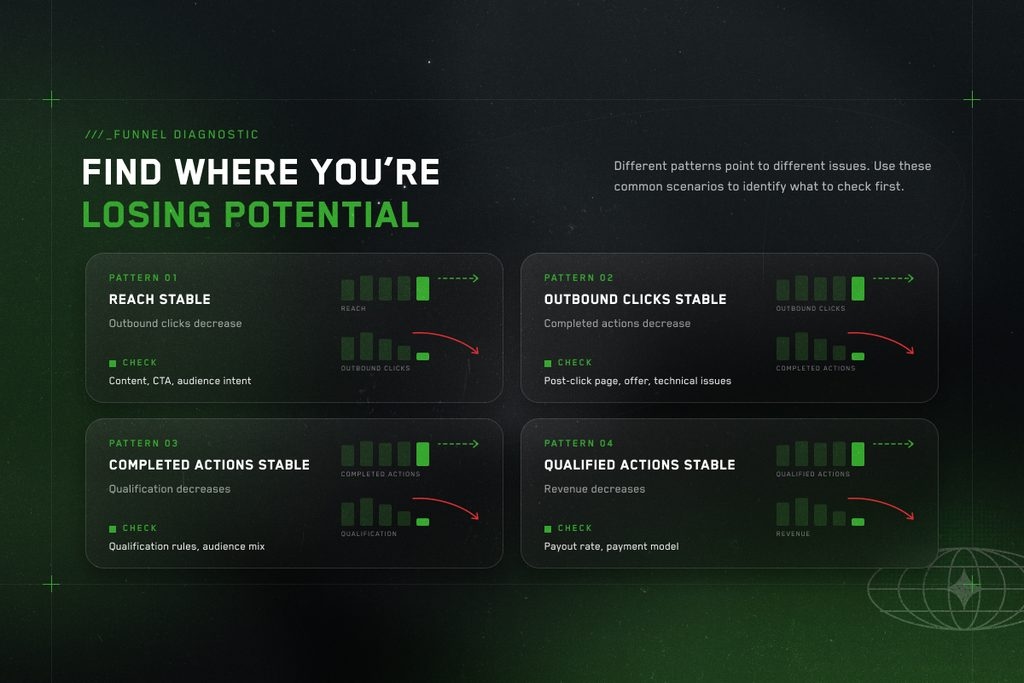
How to Improve Affiliate Marketing Performance
Improvement starts with identifying the stage that needs attention, not rebuilding the entire path. Affiliates should use metric changes to decide where to investigate first.
- Match content to audience intent, so the pre-sell content fits what brought the visitor in.
- Reduce unnecessary steps, since every additional step creates another point where users can leave.
- Keep tracking consistent, so you can connect changes in results to actual funnel performance rather than a tracking gap.
- Test one major change at a time, so it is easier to identify what affected performance.
Extra confirmation screens, unnecessary form fields, and redirects create additional points where users can leave the funnel. Review each step and remove the ones that users do not need to complete the tracked action.
How to Find, Onboard and Scale Affiliate Partners
The funnel also depends on the partners sending traffic into it. When selecting affiliates, advertisers can look beyond audience size and consider audience fit, content type, acquisition channel, GEO coverage and available source-level reporting. Website-level traffic alone does not show how visitors enter the funnel.
Onboarding connects the partner with the conditions used later to measure results. Affiliates need the relevant tracking setup, qualification rules, permitted promotion methods, available GEOs and payment terms. Banners, approved copy, offer descriptions and other creatives also help keep the message consistent between affiliate content and the offer.
Partner-level reporting then shows how traffic progresses beyond the initial click. Comparing completed and qualified actions across affiliates can identify differences that traffic volume alone does not reveal. The same principle applies to creatives: comparing outbound clicks with later funnel stages separates materials that attract attention from those associated with downstream results.
These results provide a basis for further partner and creative decisions. Additional materials, new offers, different placements or closer account support can then be considered using the same funnel metrics rather than click volume alone.
Affiliate Program Conditions That Affect Results
An affiliate program defines several conditions that affect the commercial result, including the qualifying action, attribution window, GEO, permitted promotion methods, commission rates, and payment model.
Commission rate alone does not give affiliates enough information to compare two programs. Different qualification and attribution rules can change the commercial result even when the audience and customer journey are similar.
Affiliates should check these conditions before launch so they can interpret later changes in conversion against the same baseline.
Common Affiliate Funnel Mistakes
Several common mistakes make affiliate marketing results harder to measure and compare:
- Measuring only the final result instead of each stage along the way.
- Sending every audience through the same customer path regardless of how they arrived.
- Adding unnecessary steps that do not help the visitor complete the required action.
- Ignoring qualification rules until the final result becomes available.
- Mixing several campaigns under one tracking label, which makes it harder to see which one drives sales.
- Changing several stages during the same test.
- Comparing affiliate programs without first checking their payout terms and attribution rules.
Affiliate Marketing with Growe Partners
Before launching a campaign, affiliates should check the product, GEO, promotion requirements, qualification rules, and partnership conditions. These details help affiliates determine whether an offer fits the planned customer journey before they launch traffic.
Explore available partnership opportunities with Growe Partners.


