///_Articles
Best iGaming Traffic Sources in 2026: Organic vs Paid

iGaming traffic can come from search, publisher and affiliate content, video platforms, paid advertising, display inventory and several other acquisition channels. Beyond reach, these sources differ in user intent, targeting options, attribution, cost structure and market availability.
For betting traffic sources, market availability requires particular attention. A channel available in one GEO may have different licensing, advertising or platform requirements in another. A useful comparison looks at how a channel acquires visitors and at the conditions under which that traffic can actually be used.
The sections below cover organic and paid channels one by one, then compare them on the same criteria: GEO, intent, targeting, quality, cost, tracking and compliance.
What Are iGaming and Betting Traffic Sources?
A traffic source is the channel through which a visitor reaches a publisher’s content or an advertiser’s destination. In iGaming, that covers everything from a search result to a banner on a third-party site. Four terms tend to get mixed up, so it helps to define them early:
- Organic: the visitor arrives without a purchased ad impression or click
- Paid: the traffic is bought through ad inventory
- Platform: the environment where acquisition happens, such as a search engine, a video site or an ad exchange
- Format: the specific shape of a placement inside a platform, such as a banner or a native unit
The distinction matters because display advertising, an ad network and a banner describe different parts of the acquisition process: an advertising channel, an intermediary and an ad format. Treating them as equivalent makes traffic source comparisons less precise.
Organic vs Paid iGaming Traffic
Organic and paid channels solve the same problem, which is getting a relevant visitor to a page, but they do it through different mechanics. The table gives a first overview before the individual channels are covered.
| Factor | Organic | Paid |
| Discovery | Search, content, referrals, audience | Ad inventory |
| Cost structure | Content and distribution costs | Media spend plus production |
| User intent | Depends on query and content context | Depends on placement and audience settings |
| Targeting control | More limited | Platform-dependent audience controls |
| Measurement | Source and content attribution | Campaign, placement and ad-level data |
| Availability | Depends on the distribution platform | Depends heavily on ad and market rules |
Visit counts alone cannot settle a comparison between the two. A thousand visitors from a comparison query and a thousand from a display placement arrive with different context.
Organic iGaming Traffic Sources
Organic channels differ in how the visitor finds the content, and that shapes what the content has to do once they arrive.
Organic Search
Search provides a direct intent signal because the query shows what the visitor is looking for. An informational query, a comparison query and a branded query can all lead to the same site while representing three different starting points.
SEO content matches those starting points with different page types: informational articles, comparison pages, reviews, guides and a search-focused landing page for the offer itself. Each page type addresses a different search intent, so the right format depends on the query and audience rather than on a single format performing best across all searches.
Affiliate and Publisher Websites
An affiliate website is an asset, and it is not a traffic source in itself. Search is one way it can receive visitors, alongside direct visits, referrals and other channels. The two are easy to confuse, and confusing them hides where a publisher’s audience actually comes from.
For an operator reviewing an affiliate partner, the distinction matters because website-level numbers do not show where the audience originated. Search, referral, direct and paid traffic can behave differently even when they reach the same site.
Content Communities
Discovery here happens inside a content or audience environment, with no search query starting it. This includes forums, groups and other communities where people exchange opinions about betting, as well as social media accounts focused on sports or casino topics.
Because nobody typed a query, the content has to supply the context that a search would otherwise provide. Gambling content in these environments is also subject to each platform’s own rules and to local age and ad requirements, which vary by market.
Video and Streaming Content
Video discovery behaves differently from search-led discovery. A viewer usually starts with a creator or a topic and meets a mention of a betting or casino product along the way, which makes it a content-led path instead of a query-led one.
That path complicates measurement. Someone may watch a video, leave, and visit the site later through a direct or search visit, so the link between the content and the result is easy to lose when tracking is not set up in advance. Platform rules for betting-related video also differ and need to be checked before anything is published.
Paid iGaming Traffic Sources
Paid channels buy visibility directly. What differs between them is the environment the ad appears in, and that environment shapes intent, cost and the rules that apply.
Paid Search
Paid search shares one trait with organic search: a query supplies context. The difference is that the placement is purchased ad inventory, so it is governed by advertising policy as well as by relevance.
This is also the first place where compliance becomes practical. The fact that a search platform sells ads does not mean a specific gambling campaign is allowed in the chosen GEO. Google, for example, requires certification for gambling-related ads, limits them to approved countries, requires relevant responsible gambling information on the landing page and does not allow targeting of minors.
Display Advertising
Display ads reach a visitor while they read or watch something else, usually with no product query behind the impression. Placement and audience context carry more weight than they do in search.
The common ad formats show the range:
- Display banners: fixed-size image or animated units on publisher pages
- Native placements: units styled to match the page around them
- Video ads: pre-roll or mid-roll clips
- In-feed ads: paid units displayed within a publisher’s content feed
These ad formats are one layer; the networks and exchanges that sell them are another.
Ad Networks
An ad network sits between advertisers, including affiliate programs, and publishers who have inventory. Ad networks differ mainly in inventory, GEO availability, reporting, supported ad formats, targeting capabilities and compliance controls.
A ranking of ad networks by name can become outdated as inventory, GEO coverage and policies change. A more useful comparison looks at accepted countries and gambling categories, licensing or approval requirements, placement-level reporting and controls for invalid traffic.
Native Advertising
Native ads are integrated into the surrounding publisher content and match the look of the placement, but they remain paid promotion. Disclosure rules apply to them, and those rules differ between markets and platforms.
Native units can be bought directly from publishers or through an ad network, so the same placement may be reachable by more than one route. The terms, reporting and approval rules can differ between those routes even when the placement looks identical.
Programmatic Advertising
Programmatic refers to the automated buying of ad inventory. It describes how inventory is bought and says nothing about how an ad looks.
Display describes where and how ads appear, so the two terms answer different questions. A display banner can be purchased programmatically or directly from a publisher.
Other iGaming Traffic Sources
Several other channels also appear in iGaming acquisition alongside search, display, native and programmatic advertising.
Paid social uses paid placements on social platforms and typically relies on audience, contextual and platform-specific targeting options. Availability and advertising rules vary significantly by market and platform.
Push traffic comes from notification-style ad placements delivered through websites or apps. Popunder traffic opens an advertiser’s page behind the active browser window. Both formats are usually bought as paid inventory and can differ widely in placement quality, GEO availability and platform restrictions.
In-app advertising reaches users inside mobile applications through formats such as banners, native units and video placements. Its performance and availability depend on the app inventory, audience and advertising rules that apply to the market.
Influencer traffic comes from creators and their audiences on social, video and streaming platforms. Attribution can be less direct than with standard paid ads, especially when users return later through search or direct visits.
Email traffic comes from messages sent to an existing subscriber base, while referral traffic reaches a site through links on other websites or digital properties. Both should be tracked separately from search and direct traffic to preserve accurate source attribution.
How to Compare iGaming Traffic Sources
Comparing channels by volume alone hides most of what matters. The factors below apply to organic and paid sources alike, and they are the basis for the traffic mix discussed afterwards.
GEO and Market Availability
GEO is more than a targeting field. It can decide whether an ad category is available at all, which products may be promoted, what licensing applies, whether a platform certification is needed and which audiences must be excluded.
Google’s policy shows how far this goes. Online gambling and gambling-promoting content are allowed only in listed countries, and only when country-specific certification criteria are met. Affiliate and aggregator content is handled under separate conditions on the platform. A channel available in one market may be restricted or unavailable in another.
Audience Intent
Someone who enters a specific comparison query has already expressed intent through search. A person who meets a display placement while reading unrelated content has not given the same signal.
In iGaming, two visits can look identical in a report and still come from very different contexts, so intent has to be read alongside volume.
Targeting Options
Targeting options depend on the source and platform. Search uses query intent, while display and social platforms rely more on audience and contextual signals. Some channels offer only broad placement controls.
Comparing sources on this point means looking at what each one allows: GEO, language, device, contextual signals and permitted audience criteria. Age-related advertising restrictions can further limit available targeting options. The applicable minimum age and targeting requirements depend on the market and platform.
Traffic Quality
Traffic volume measures how many visits a source generates. Traffic quality describes how closely that audience matches the permitted campaign criteria and how much of the activity produces attributable, valid results.
Two sources can each generate 10,000 visits but produce different numbers of attributable and valid results. They may also differ in GEO distribution, invalid traffic or audience relevance. Traffic volume has to be read alongside quality indicators; it is not the result itself.
Cost and Pricing Models
Three pricing bases come up most often:
- CPM: cost is tied to impressions
- CPC: cost is tied to clicks
- CPA: cost is tied to a defined qualifying result
These models describe what the buyer pays for, which is different from what the campaign produces. A low CPC, for example, does not show whether those clicks result in valid conversions. None of the three pricing models can be evaluated from the headline rate alone.
Tracking and Attribution
Tracking shows where a visit came from. Attribution connects a later result to the source, campaign or touchpoint associated with that visit. The first is traffic measurement and the second is outcome measurement, and mixing them up is a common reason two reports disagree.
Source and campaign identifiers make it possible to split results by channel, campaign, placement or GEO. Without them, conversions from several channels collapse into a single number, and a strong source can hide a weak one.
Compliance Requirements
In iGaming, compliance belongs inside the source decision itself. Three levels of checks help:
- Market rules: what the law of a given GEO allows
- Platform rules: what the ad or distribution platform permits
- Advertiser or affiliate program requirements: which sources and formats a specific advertiser or program accepts
A channel has to pass all three checks. Market permission does not automatically mean platform permission, and platform permission does not automatically mean that a specific affiliate program accepts the source. Current requirements need to be checked at each level.
How to Evaluate a Traffic Mix
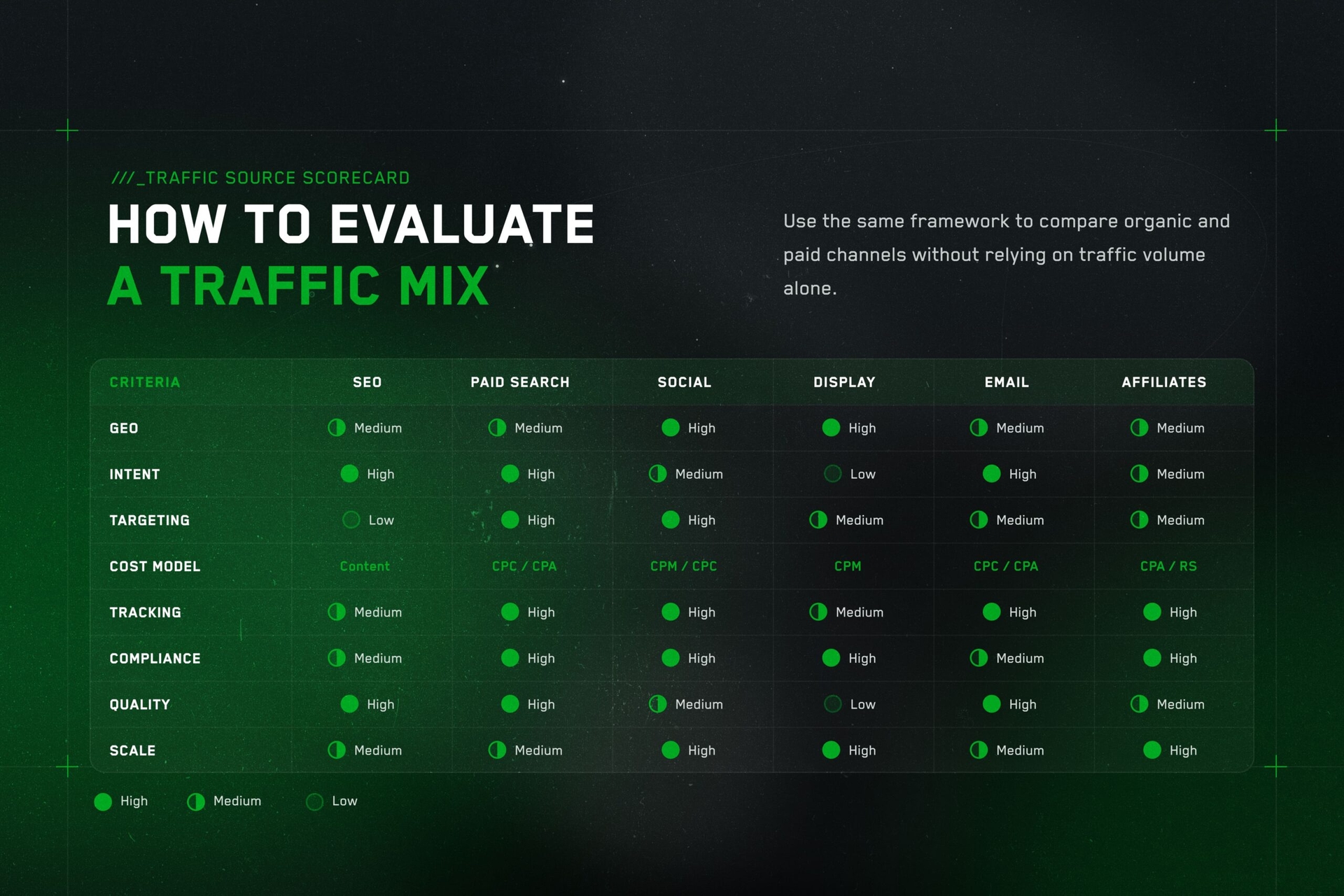
Once these factors are defined, the same framework can be applied to every channel in the traffic mix. This makes organic and paid sources easier to compare without relying on traffic volume alone.
| Factor | What It Tells You |
| GEO | Whether the channel is available under relevant requirements |
| Intent | How the audience encountered the content |
| Targeting | Which audience and context controls exist |
| Cost model | What the ad cost is based on |
| Tracking | What can be measured by source or campaign |
| Compliance | Which market and platform restrictions apply |
| Quality | How the traffic relates to valid outcomes |
| Scale | How much relevant inventory or audience exists |
Comparing Sources Consistently
Raw traffic volume alone does not show which source produced the stronger result. A fair comparison needs the same definitions for attribution, conversions, GEO and qualification on every source, and the same reporting period. Without that, differences in the numbers may come from how each source was measured rather than how it performed.
Consistent testing follows the same principle. New sources can be compared using the same offer, GEO, reporting period and measurement definitions, with results recorded by source and campaign identifier. Changing one major variable at a time also makes differences easier to interpret.
Practical testing also includes working with whitelists and blacklists at the placement or source level, testing different creatives and monitoring how each variation affects campaign results. As enough data is collected, the budget can be redistributed between sources, placements or creatives based on performance. The same measurement criteria should be kept throughout the test so that changes in CPA, conversions and valid results can be compared consistently.
The same data can then be used to evaluate scale. Higher volume is meaningful only if valid results remain consistent and the traffic continues to meet market, platform and program requirements.
What to Measure
The core metrics are:
- Visits or clicks
- Impressions and CTR, where applicable
- CPC or CPM, where applicable
- Conversions and conversion rate
- CPA
- Valid or approved results, where available
Universal benchmark figures are difficult to apply here because acceptable results depend on the GEO, product and offer terms. Performance should therefore be evaluated against comparable campaign data rather than a single benchmark.
iGaming Traffic with Growe Partners
Traffic requirements can differ between products, offers and markets. Available GEOs, accepted traffic types and qualification conditions should therefore be checked at offer level rather than assumed to apply across an entire affiliate program.
Growe Partners works across casino and betting products, with conditions defined for specific offers. Affiliates can review the available opportunities and current requirements with the Growe Partners team before evaluating which traffic sources fit a particular offer.
FAQ
What Are the Main iGaming Acquisition Channels?
The main groups include organic search, publisher and community content, video-led traffic, paid search, display, native and programmatic advertising. Some paid inventory is bought directly from publishers and some through intermediary networks.
What Is the Difference Between Organic and Paid Traffic?
Organic traffic reaches a page without a purchased ad impression or click. Paid traffic is bought through ad inventory, so it depends on media spend and on ad and market rules.
What Determines Traffic Quality?
Audience relevance, GEO match, attribution and the share of valid results. Volume on its own says little about quality.
Why Does GEO Matter When Comparing Traffic Sources?
GEO affects more than audience targeting. It can decide whether a channel is legally and technically available at all, because regulation and platform rules differ by market.
Why Is Tracking Important When Comparing Traffic Sources?
It separates volume from attributable results. Without source and campaign identifiers, results from different channels cannot be told apart.
What Is the Best iGaming Traffic Source for Beginners?
There is no single traffic source that works best for every new affiliate. The choice depends on the target GEO, available resources, accepted traffic types, tracking capabilities and the restrictions that apply to the specific platform and offer. Comparing these factors gives a more useful starting point than choosing a channel based on traffic volume alone.
How Can You Identify Low-Quality or Fraudulent Traffic?
Low-quality or potentially fraudulent traffic can show unusual patterns in GEO distribution, attribution, engagement or the share of results that remain valid after verification. A large gap between reported clicks and attributable or approved results can also indicate that a source needs closer review. Comparing source, placement and campaign data helps separate traffic volume from traffic that produces valid outcomes.