///_Uncategorized
Best Traffic Sources for Affiliate Marketing in 2026: Paid vs Organic

Choosing a traffic source starts with a simple question: what kind of audience does the offer need?
Search traffic captures existing demand. Social media and YouTube can reach users earlier in the decision process. Email works with an audience that already knows the publisher, while paid channels provide more control over targeting and testing speed.
These channels also have different cost structures and performance signals. A high-volume source may produce weak conversion quality, while a smaller channel can deliver more relevant traffic at a lower acquisition cost. That is why visits, clicks, or CPC alone are not enough for comparison.
This guide looks at the best traffic sources for affiliate marketing, how paid and organic traffic differ, and which metrics help compare, test, and diversify channels based on actual performance.
Key Takeaways
- Paid traffic usually provides faster feedback and more control over distribution, while organic traffic takes longer to build and can continue generating visits from existing content.
- Traffic volume should be evaluated together with conversion and qualification data.
- Organic traffic has no direct media cost per visit, but content production, SEO, video, tools, and maintenance still carry costs.
- Search, social media, YouTube, and email reach audiences with different levels of intent and prior exposure.
- Poor conversion does not always indicate a poor traffic source. The problem can also sit on the landing page or further down the funnel.
- Diversification is most useful once individual traffic sources can be measured separately.
What Is a Traffic Source in Affiliate Marketing?
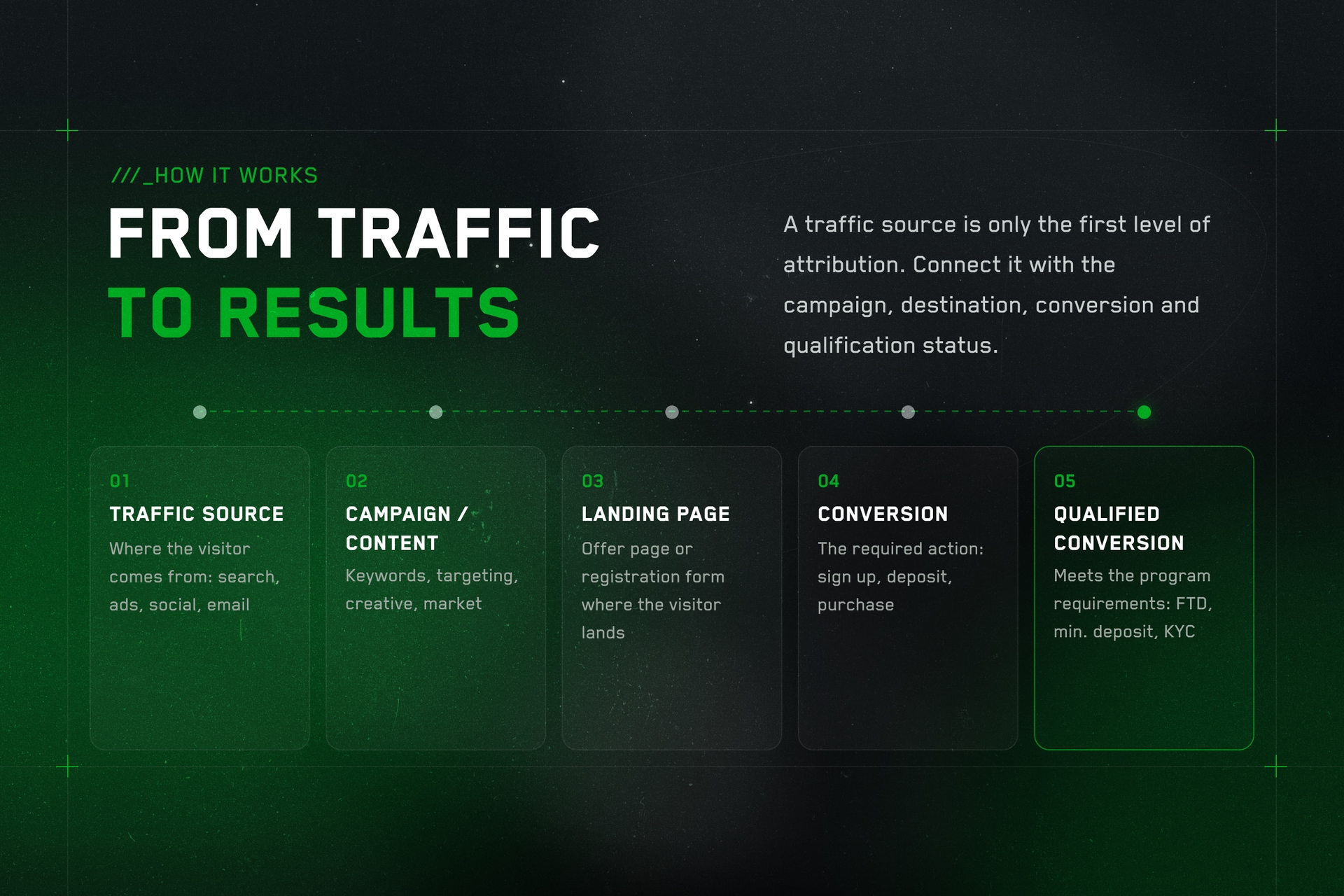
A traffic source identifies where a visitor came from before reaching affiliate content, a landing page, or an offer.
Google Search, Google Ads, YouTube, Instagram, and email can all generate traffic for affiliate marketing. For reporting purposes, however, the source is only the first level of attribution.
Consider two campaigns running on the same advertising platform. They may target different queries, audiences, or markets and send users to different destinations. Grouping all of that activity under one source removes information needed to explain why one campaign performs differently from another.
Affiliate marketers should be able to connect the source with the relevant campaign or content, destination, conversion, and qualification status. This makes it easier to locate performance changes instead of assigning every gain or loss to the channel itself.
Paid Traffic vs Organic Traffic
Paid and organic traffic differ primarily in how distribution is acquired.
Paid traffic uses advertising spend to reach an audience. Campaigns can begin generating impressions and clicks soon after launch, and marketers have direct control over variables such as budget, targeting, and placements.
Organic traffic comes from search visibility, content discovery, social media reach, video recommendations, subscribers, and other non-paid distribution. Growth is usually slower, but published content can continue generating visits without buying every additional click.
| Factor | Paid Traffic | Organic Traffic |
| Time to initial data | Usually shorter | Usually longer |
| Media spend | Direct advertising cost | No direct media cost per visit |
| Distribution control | Higher | More dependent on platforms and rankings |
| Testing | Faster feedback | Longer validation period |
| Scaling | Usually requires more spend | Existing assets can continue producing traffic |
| Main costs | Media, creative, tracking | Content, SEO, production, tools |
| Main dependencies | Budget, platform policies | Rankings, algorithms, audience reach |
The term free traffic can be misleading. Organic distribution does not carry a direct CPC, but content production, search engine optimization, video, tools, and maintenance still require resources.
Those costs become relevant when organic and paid traffic are compared at conversion level. The cost structure is different, but neither source should be treated as cost-free.
For affiliate marketing, the more useful comparison is what each model costs to produce a relevant result over time.
Organic Traffic Sources for Affiliate Marketing
Organic channels differ mainly in how users discover the content and how much intent exists before the visit. Those differences affect both content format and the metrics used to evaluate performance in affiliate marketing.
SEO and Content Marketing
Search engine optimization is most relevant when identifiable search demand exists around the problem, category, or product connected to affiliate offers.
Search volume is only one part of that demand. Query intent determines what visitors expect to find.
An informational search such as “how does cloud storage work” represents a different stage from a comparison query such as “cloud storage X vs Y.” Both can produce organic traffic, but the visitors are at different stages of consideration.
That difference becomes visible further down the funnel.
| Metric | Page A | Page B |
| Organic visits | 12,000 | 3,000 |
| Affiliate clicks | 600 | 450 |
| Conversions | 48 | 72 |
| Visit-to-conversion rate | 0.4% | 2.4% |
Page B receives 75% fewer visits but produces 50% more results.
Rankings and organic sessions show how visible the page is. Offer clicks and qualified actions show how well that traffic performs for affiliate marketing.
YouTube and Video Content
YouTube works across both search and discovery. Users can find a video through a direct query, recommendations, subscriptions, or related content.
Video is especially useful when a topic benefits from explanation, demonstration, or comparison before the user visits an offer. The acquisition context also matters: a viewer searching for a specific comparison arrives with different intent from someone who encounters the same video through recommendations.
For YouTube, views measure distribution, while outbound clicks show how effectively the content sends users beyond the platform. Conversion and qualification data then show the quality of those visits.
This distinction matters in affiliate marketing because a focused comparison with a relatively small audience may send more relevant traffic than a broad educational video with substantially more views.
Organic Social Media
Organic social media is usually more discovery-led than search. Users on Instagram may encounter content without actively looking for the product or category.
Reach and engagement help explain distribution, but affiliate marketing performance depends on how many users continue beyond the platform.
The relationship between reach and outbound traffic is particularly useful here. If reach increases by 40% while outbound clicks remain flat, the additional distribution is not producing more traffic for the affiliate funnel. The cause may sit in audience relevance, content intent, or the transition from the post to the external destination.
Social media reporting should therefore connect reach and engagement with outbound clicks and subsequent conversions rather than treating follower count or impressions as final performance metrics. The same principle applies when comparing Instagram with other social media channels: platform reach needs to be connected to what users do next.
Email Marketing
Email marketing works with an existing subscriber base rather than relying on a new search ranking or platform recommendation for each visit.
Subscribers already have some history with the publisher, so their conversion rates should not be benchmarked directly against first-time visitors from paid or social media.
Open rate can help diagnose subject-line or deliverability performance, but clicks are more relevant when evaluating affiliate marketing traffic. Conversion and qualification data show what happens after subscribers leave the inbox.
If clicks decline while post-click conversion remains stable, the issue is likely within the email or audience engagement. If clicks remain stable but conversions fall, the destination or offer deserves closer analysis.
What Does Organic Traffic Cost?
Organic traffic still needs a cost model if it is going to be compared with paid traffic.
For SEO and content marketing, costs can include research, writing, editing, design, tools, technical work, and maintenance. Video adds production costs. Email marketing requires software and audience development.
Suppose a content operation costs $3,000 per month and produces 300 qualified conversions. Its direct content cost is:
$3,000 ÷ 300 = $10 per qualified conversion
The calculation does not capture every overhead cost, but it provides a more realistic benchmark than assigning organic traffic a cost of zero.
It also gives organic and paid channels a common point of comparison: the cost of producing a qualified result rather than the cost of generating a visit.
Paid Traffic Sources for Affiliate Marketing
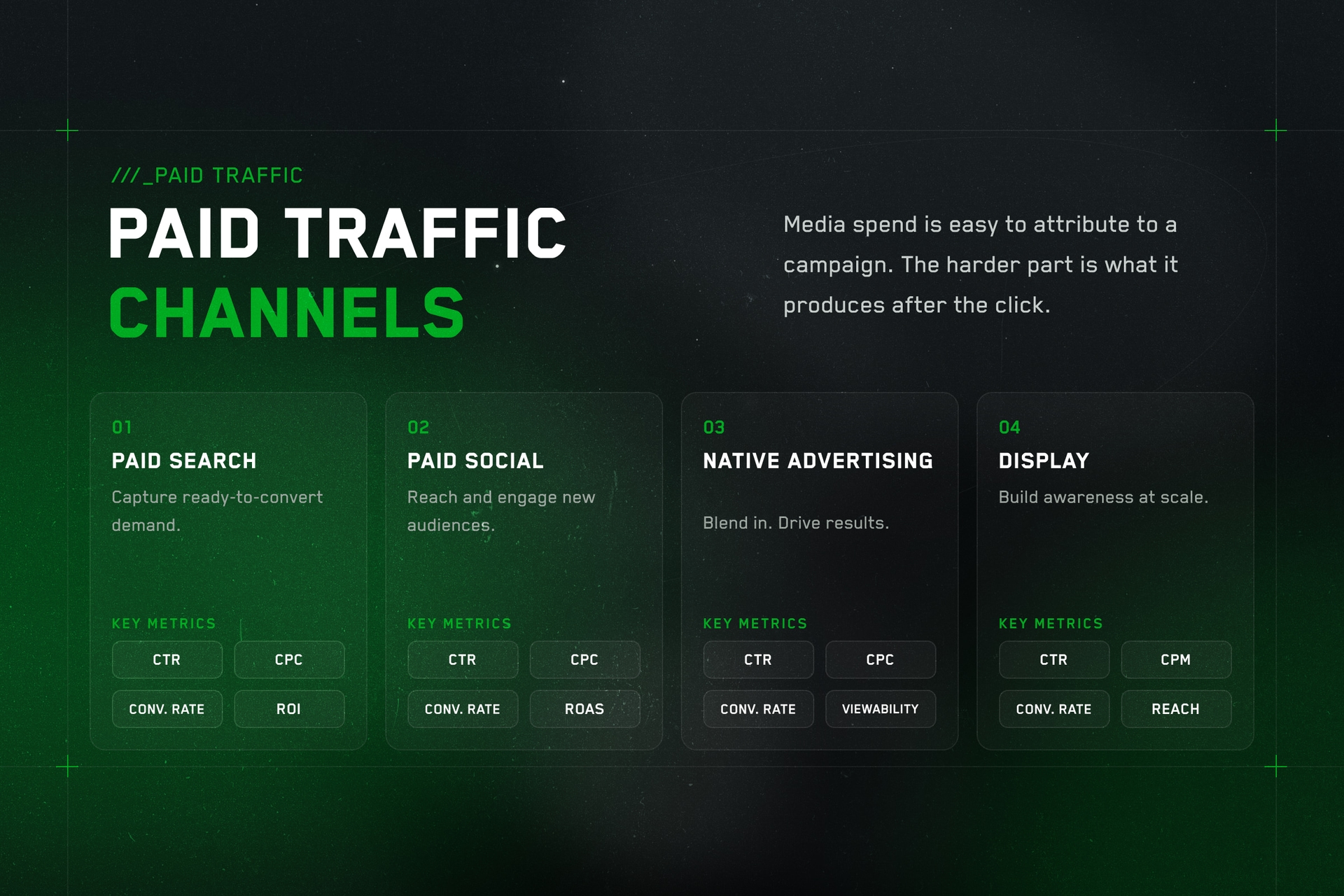
Paid traffic sources are easier to compare on acquisition cost because media spend can be attributed directly to campaigns. The harder part is determining what that spend produces after the click.
CPC, CPM, and CTR describe media efficiency. Conversion and qualification metrics show how efficiently the acquired audience performs.
Google Ads and Paid Search
Google Ads can reach users who have already expressed intent through a search query. Campaign structure can then separate traffic by keywords, markets, devices, or other permitted parameters.
CPC is often the first metric used to compare campaigns, but cheaper clicks can become more expensive further down the funnel.
Consider two campaigns:
| Metric | Campaign A | Campaign B |
| Clicks | 5,000 | 3,000 |
| CPC | $0.80 | $1.40 |
| Spend | $4,000 | $4,200 |
| Conversion rate | 1.5% | 4% |
| Conversions | 75 | 120 |
| Cost per conversion | $53.33 | $35.00 |
- Campaign B pays 75% more for each click but delivers results at a lower acquisition cost.
Qualification changes the comparison further. If 60% of Campaign A results meet the required criteria, it produces 45 qualified actions at $88.89 each. At an 80% qualification rate, Campaign B produces 96 at $43.75 each.
- Campaign A buys cheaper clicks, but the final acquisition cost is $88.89 per qualified action compared with $43.75 for Campaign B.
Paid-search analysis should connect CPC with qualification rate and final acquisition cost. Google Ads policies, GEO, and product category also need to be checked before the channel is included in a traffic plan.
Paid Social Media
Paid social media reaches audiences without requiring an active search query. Performance depends on the target audience, creative, placement, and what happens after the click.
CTR shows how well an ad attracts clicks, but it does not show the quality of the resulting traffic. A campaign with a higher CTR can still produce more expensive qualified actions if the additional visitors perform poorly after reaching the destination.
For paid social media, compare CTR and CPC with qualification rate and cost per qualified action.
This also helps separate creative performance from traffic quality. Strong CTR followed by weak downstream results points to a different issue than low CTR from traffic that performs well after the click.
Native Advertising
Native advertising often places content between the initial advertisement and the affiliate offer.
That additional stage should be measured separately. If users click the native ad but leave the content page before reaching the offer, the main loss occurs before the offer itself.
For example, if 10,000 users reach an article and 4,000 continue to the offer, the content-to-offer click rate is 40%. If 200 of those users convert, the offer conversion rate is 5%.
If the content-to-offer rate falls while offer conversion remains stable, the problem sits before the offer. If the first rate remains stable and offer conversion falls, the investigation moves further down the funnel.
Display and Other Paid Traffic Sources
Display and other advertising channels can provide reach across websites, apps, and other placements.
Low CPM or CPC can make a campaign look efficient at media-buying level, but cheap distribution has limited value if the resulting audience does not convert.
For affiliate marketing, media metrics explain how efficiently traffic was acquired. Conversion rate, qualification rate, and cost per qualified conversion show what that traffic produced.
Traffic Volume vs Traffic Quality
Traffic quality becomes clearer when volume, conversion, qualification, and cost are considered together.
| Metric | Source A | Source B | Source C |
| Visits | 20,000 | 10,000 | 5,000 |
| Conversions | 300 | 250 | 175 |
| Conversion rate | 1.5% | 2.5% | 3.5% |
| Qualified conversions | 120 | 175 | 140 |
| Qualification rate | 40% | 70% | 80% |
- Source A has the most visits and total results. Source B produces the highest number of qualified actions, while Source C records the strongest qualification rate.
Cost changes the comparison again. If Sources A, B, and C cost $3,000, $4,000, and $3,500, respectively, the cost per qualified action is $25, $22.86, and $25.
- Source B receives half as many visits as Source A, yet produces 46% more qualified actions and reduces the cost per qualified result from $25 to $22.86.
How to Choose a Traffic Source
Channel selection starts with the target audience and the conditions surrounding the affiliate offer.
- Search Demand
If users already search for the problem, category, or product, SEO and paid search can capture existing demand.
The type of query matters as much as its volume. Informational, comparison, and product-specific searches represent different levels of intent and should be analyzed separately.
- Audience Temperature
A first-time visitor from paid social and a returning email subscriber do not enter the funnel with the same level of familiarity.
Cold traffic may require more information before conversion. Returning users already have context from previous content or interactions.
Conversion benchmarks should account for that difference.
- Format
The amount and type of information required before conversion can narrow the list of suitable traffic sources.
| Situation | Channel to Evaluate |
| Existing search demand | SEO / Paid Search |
| Detailed explanation required | Content Marketing |
| Visual demonstration matters | YouTube / Video |
| Discovery-led target audience | Social Media |
| Existing subscriber base | Email Marketing |
| Faster initial data needed | Paid Traffic |
| Long-term search opportunity | SEO / Content |
The table identifies channels worth evaluating. Actual performance still depends on the audience, offer, market, and execution.
- Testing Requirements
Channel choice also depends on how quickly the team needs reliable performance data.
Paid acquisition can generate a larger test sample in a shorter period when sufficient budget is available. Organic channels may require longer observation because distribution depends on rankings, recommendations, or audience growth.
The test should also produce enough conversions to support a useful comparison. Early results from a very small sample can indicate a direction, but they should not be treated as a stable affiliate marketing benchmark.
- Traffic and GEO Restrictions
Traffic type, GEO, and promotional format need to be checked before content production or media spend begins.
This is particularly important for affiliate offers in regulated verticals, where advertising rules can differ between markets and platforms.

Find the Drop-Off Before Changing the Channel
When performance changes, identify where the change occurred before replacing the traffic source.
| Pattern | Area to Investigate |
| Impressions stable, CTR down | Creative, message, audience |
| Clicks stable, conversion down | Landing page, offer presentation |
| Conversions stable, qualification down | Traffic mix, audience quality, qualification rules |
| Several stages decline together | Tracking, delivery, broader campaign changes |
Suppose weekly paid traffic remains at 8,000 clicks while conversions fall from 320 to 200. The conversion rate has dropped from 4% to 2.5%, a 37.5% decline, while click volume has not changed.
With click volume unchanged, the loss is occurring after the visit rather than at the traffic-acquisition level. The landing page, offer presentation, technical flow, and composition of the audience should be checked before acquisition is changed.
This distinction matters in affiliate marketing because replacing a source will not fix a problem that occurs after users have already arrived.
Metrics for Comparing Affiliate Traffic Sources
Different channels use different metrics, but the goal is the same: understand traffic quality, cost, and value.
| Metric | Formula | What It Measures |
| CTR | Clicks ÷ impressions × 100 | Response to an ad or placement |
| Conversion rate | Conversions ÷ clicks × 100 | Results after the click |
| Qualification rate | Qualified actions ÷ total actions × 100 | Quality of results |
| CPC | Spend ÷ clicks | Cost of paid traffic |
| Cost per result | Spend ÷ total actions | Acquisition cost |
| Cost per qualified action | Spend ÷ qualified actions | Cost of a qualified result |
| Revenue per click | Revenue ÷ clicks | Value generated per click |
| ROI | (Revenue − cost) ÷ cost × 100 | Return relative to cost |
Channel-specific diagnostic metrics still matter. Rankings can explain changes in SEO traffic, while delivery data can explain changes in email performance.
For cross-channel affiliate marketing analysis, conversion rate, qualification rate, acquisition cost, and revenue provide a more consistent basis.
How to Test a New Traffic Source
A good traffic source test needs clear conditions from the start.
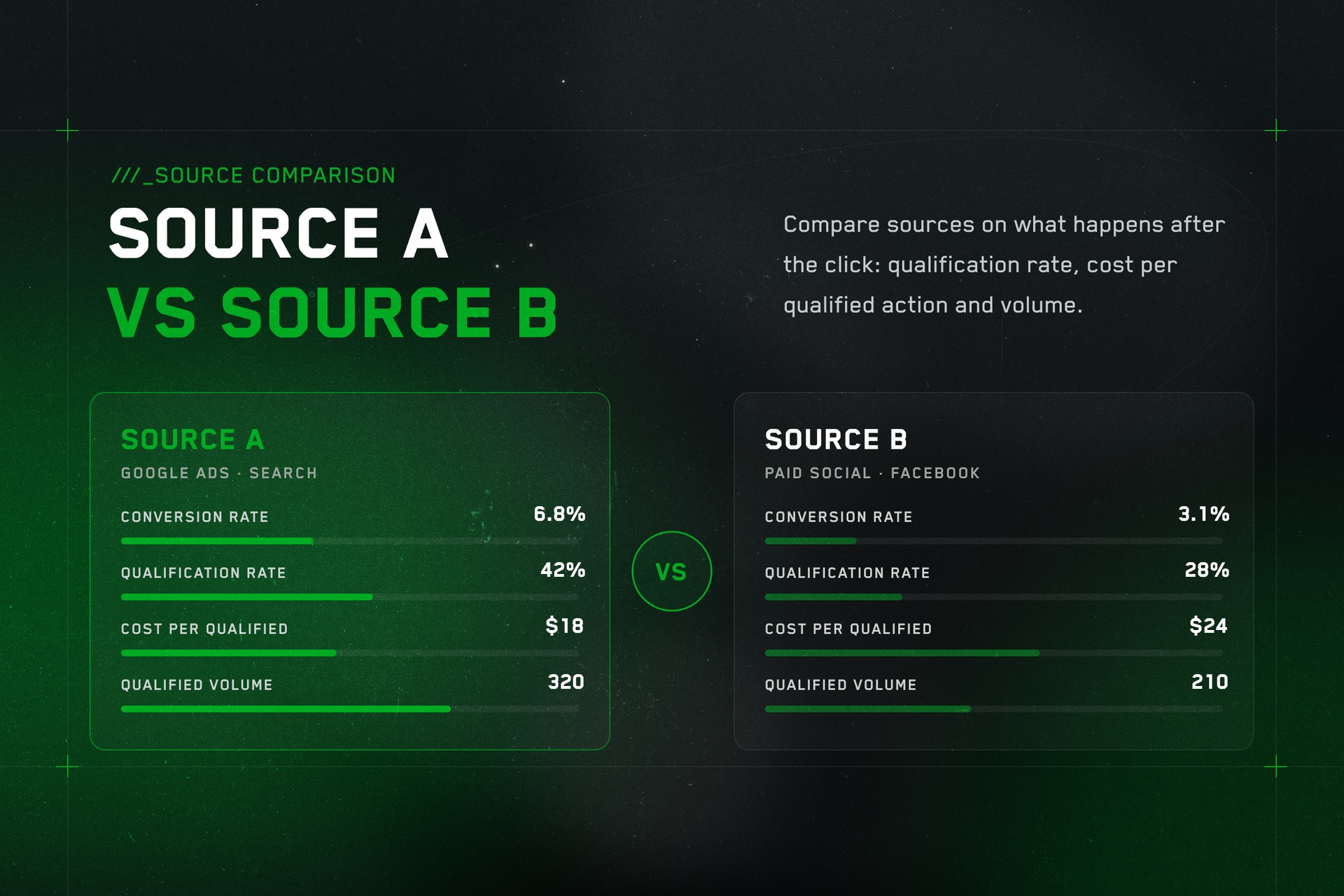
Before launch, decide what results the new source needs to reach. This may be a target cost per qualified action, a minimum qualification rate, or a certain volume of qualified traffic.
Keep the affiliate offer and qualification rules the same during the test. Track the new source separately. Avoid changing the target audience, creative, and landing page at the same time. Too many changes make it harder to understand what affected the results.
Give the test enough time to collect useful data. Early results can show obvious problems, but a small sample is not enough to judge a channel.
Once you have enough data, compare the new source with your current affiliate marketing benchmark. Look at qualification rate, acquisition cost, and qualified volume.
Why Diversify Affiliate Traffic Sources?
Relying heavily on one traffic source creates concentration risk.
Organic search visibility can change. Social media distribution can fluctuate. Advertising policies can be updated, and acquisition costs can rise.
Diversification reduces exposure to one channel, but adding more traffic sources does not automatically improve affiliate marketing performance. A second paid channel with a much higher cost per qualified conversion may reduce concentration while increasing the blended acquisition cost.
Diversification works best when each added channel can be measured against an existing benchmark for conversion quality and acquisition cost.
Common Traffic Analysis Errors
Several mistakes make traffic-source comparisons less reliable:
- Comparing channels by visits without conversion data
- Comparing CPC without cost per conversion
- Treating organic production costs as zero
- Combining cold and warm audiences in the same benchmark
- Sending audiences with different intent to the same generic page
- Looking at CTR without checking post-click performance
- Combining several traffic sources under one tracking label
- Changing multiple major variables during the same test
- Scaling paid campaigns before qualification data is stable
- Ignoring traffic and GEO restrictions before launch
For affiliate marketing, reporting should show where traffic came from, what happened after the visit, and what each qualified result cost.
Affiliate Traffic with Growe Partners
Growe Partners gives affiliates access to multiple casino and betting products across different markets. This makes it possible to choose an offer that fits the traffic source, target audience, and GEO rather than building a campaign around a single product.
Traffic requirements and available markets differ between products, so affiliates can review the current options before launch and select the ones that match their traffic.
Explore available products and partnership opportunities on the Growe Partners website.