///_Uncategorized
CPA Marketing: How the Cost Per Action Model Works

CPA marketing is a performance-based advertising model where payment is tied to a specific, predefined action rather than an impression or a click. An advertiser sets that requirement, an affiliate or other publisher drives traffic to the offer, and a network or direct program tracks whether the visitor completes it.
From here: the mechanics, what actually counts as a qualifying event, what CPA networks do, and how to track and optimize a marketing campaign once it’s live.
Key Takeaways
- CPA marketing pays for a specific action, such as a signup or a purchase, not for a click or an impression.
- What counts as payable is defined by the offer, and it varies from one advertiser to another.
- A CPA network connects advertisers, affiliates and influencers, tracks conversions and applies each offer’s own conditions.
- Tracking and qualification rules should be considered alongside the headline CPA rate when judging results.
What Is CPA Marketing?
CPA stands for cost per action: an advertiser pays only when a referred visitor completes a step defined by the offer. That step might be a signup, a qualified lead, a purchase or another predefined trigger, depending on what the advertiser wants to achieve.
Separating a completed step from a payable outcome matters early on, since the two aren’t always the same thing. A visitor can finish a form or a signup, but it only becomes payable once it matches the offer’s exact conditions, such as a minimum deposit, a verified signup or another specific requirement.
How Does CPA Marketing Work?
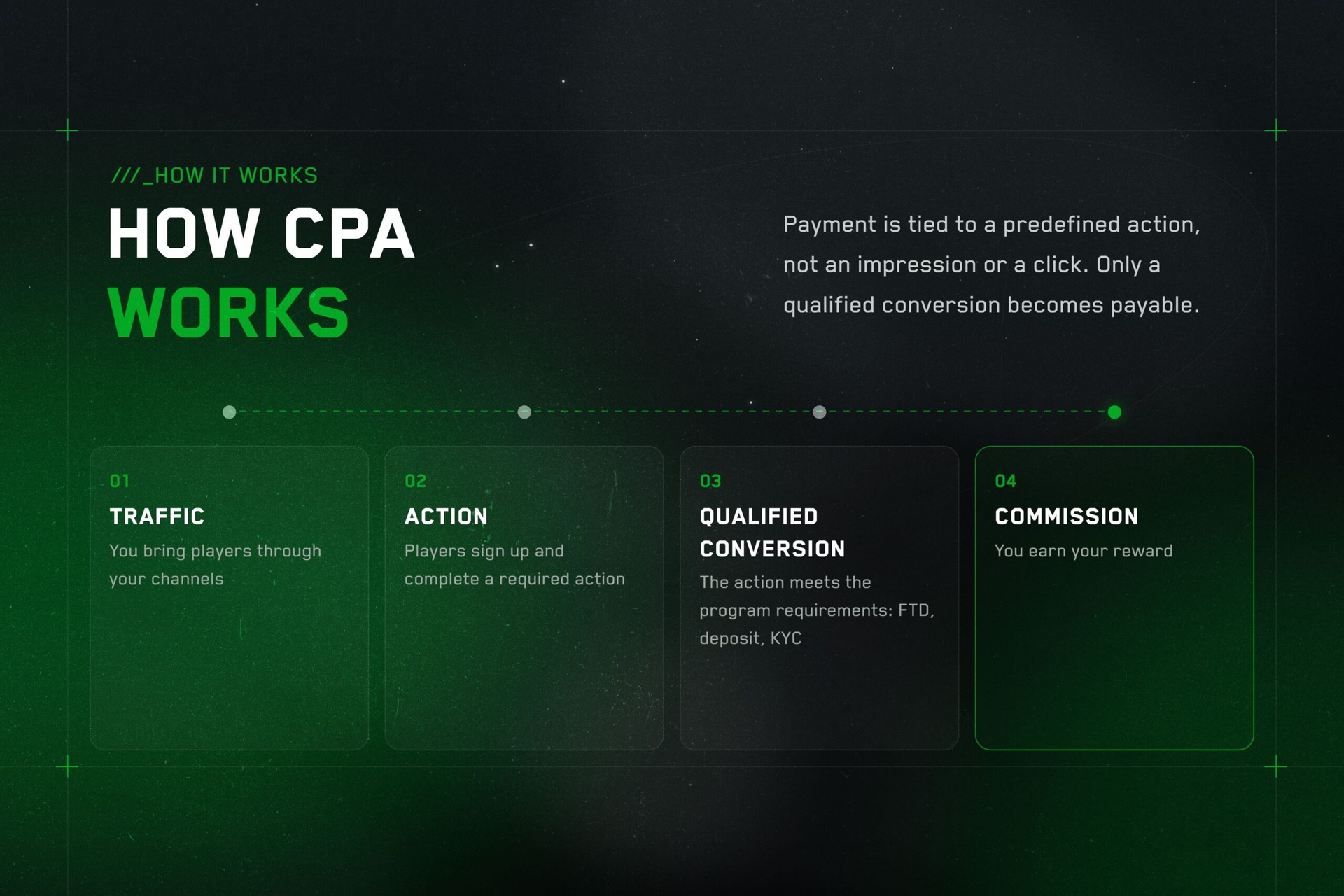
In CPA marketing, the full chain runs from advertiser to offer to affiliate to visitor to conversion to commission. An advertiser creates an offer and defines what qualifies for payment. An affiliate, influencer or other publisher then promotes it through paid or organic advertising and sends traffic through a tracked link.
A network or direct program records what that visitor does. Tracking connects the recorded step to the affiliate who referred the visitor, and the offer’s qualification rules then determine whether that action is eligible for payment.

What Counts as a CPA Conversion?
The exact requirement an offer sets is what separates a payable conversion from an ordinary completed step in CPA marketing. The required action varies by vertical: an e-commerce offer may count a completed purchase, SaaS may use a verified trial signup, while lead-generation campaigns can define a completed and verified form as the qualifying event.
The exact conditions are set at offer level. That is why the definition matters when comparing CPA programs: the same term can refer to very different qualification requirements.
CPA Marketing vs Affiliate Marketing
Affiliate marketing is the broader model: an affiliate promotes an advertiser’s product and earns a commission for referrals under several payment structures. CPA marketing defines one specific way that commission gets calculated, paying out only after a defined step rather than on an ongoing revenue-share basis.
The two concepts overlap, but they are not synonyms. Affiliate marketing describes the partnership model, while CPA describes how payment is triggered. Other affiliate agreements can use different commission structures, including revenue share. This makes CPA marketing one of the payment structures used within the broader affiliate marketing model.
What Is a CPA Network?
A CPA network sits between advertisers and affiliates. Its core functions can include connecting advertisers with affiliates and influencers who can promote to relevant audiences, giving affiliates access to multiple offers, tracking conversions back to the correct affiliate, providing campaign reporting and applying each offer’s payout terms.
None of this requires a network specifically. An advertiser can set up the same type of partnership directly with an affiliate.
CPA Network vs Direct Affiliate Program
A CPA network brings together deals from multiple advertisers on one platform, so an affiliate can access several campaigns without negotiating each one separately. A direct affiliate program instead connects an affiliate straight to one company or operator.
Neither model is inherently better. A network provides access to multiple advertisers in one place, while a direct program creates a direct relationship with a specific brand.

How to Start CPA Marketing
A CPA campaign starts with the audience and offer rather than the payout figure alone. Before traffic is sent, the affiliate needs to understand where that audience will come from, what action the advertiser expects and how the result will be tracked.
- Choose a niche and traffic source. Define the audience and the channel through which users will reach the offer, such as search, content, email or paid advertising.
- Find a CPA network or direct program. Compare available offers in the relevant niche and GEO. A network provides access to offers from multiple advertisers, while a direct program connects the affiliate with one advertiser.
- Check the offer terms. Review the qualifying action, available GEOs, permitted traffic sources, attribution rules and payout conditions. A recorded conversion does not automatically qualify for payment.
- Set up the tracked link. The affiliate link connects visits and recorded actions with the referring partner. Tracking should be checked before campaign results are evaluated.
- Launch and analyse the results. Compare traffic, recorded conversions and qualified actions to see where users leave the path and whether the audience matches the offer conditions.
How to Track and Optimize CPA Campaign Performance
CPA campaign performance becomes easier to interpret when recorded activity and qualified outcomes are tracked separately. The basic sequence shows where users continue through the campaign and where the largest differences appear:
- An audience sees the affiliate’s promotion.
- A share clicks through to the offer.
- Some visitors complete the target step.
- A smaller number meet the offer’s qualification rules.
- Qualified actions generate a commission for the affiliate.
A campaign that generates 1,000 clicks might produce 80 conversions, giving it an 8% conversion rate. If 60 of those meet the offer’s exact requirements, 75% of recorded conversions qualify for payment. The gap can come from incomplete signups, GEO restrictions or other qualification conditions.
Key CPA Marketing Metrics
A few core metrics help explain CPA performance:
| Metric | What it shows | How it’s typically calculated |
| Traffic | Volume sent to the offer | Total clicks or visits from the affiliate link |
| Conversion rate | Share completing the target step | Conversions ÷ traffic |
| Qualified actions | Accepted conversions | Conversions that meet the offer’s qualification rules |
| CPA | Cost per defined step | Total spend ÷ qualified actions |
| ROI | Relationship between cost and return | (Revenue − cost) ÷ cost × 100% |
A strong click-through rate combined with a low qualification rate can indicate a mismatch between the audience and the offer, or unusually strict qualification conditions.
How to Analyze CPA Campaign Performance
A campaign-level result can hide differences between individual segments. Breaking reporting down by GEO, traffic source, device and placement shows where recorded conversions and qualified actions come from.
Creative and landing page results can also be compared separately. If clicks change after a creative change but completed actions do not, the difference appears before conversion. If clicks remain stable while completed actions change, the landing experience or offer becomes more relevant to the analysis.
The gap between recorded conversions and qualified actions deserves separate attention. A large difference can mean visitors are completing the initial step but failing to meet the offer’s qualification conditions. Looking at that gap by segment helps distinguish differences in traffic quality from broader campaign-level changes.
Segments that generate clicks but consistently produce few qualified actions should be isolated in reporting and reviewed before additional budget is allocated to them. Where the gap persists, they can be paused while the traffic source, placement, audience or offer match is reassessed. This keeps click volume from masking differences further down the CPA funnel.
Comparing conversion rate against the qualified-outcome rate can be more informative than looking at cost or return on investment alone, since it shows how much recorded activity eventually meets the offer conditions.
What Affects CPA Campaign Performance?
Several variables can change CPA marketing results even when traffic volume stays similar. When results drop, the useful question is where the loss occurs: before the click, between the click and the completed step, or between that step and qualification. Each stage points to a different issue.
- Traffic relevance: how closely visitors match the offer
- Qualification rules: how much is required before an action becomes payable
- GEO: market differences can affect results
- Landing experience: slow or confusing pages can lose visitors before the target step
- Tracking and attribution: unrecorded or incorrectly attributed conversions distort the underlying data
A good click-through rate paired with a weak completion rate usually points to the offer or the landing experience. Flip that around, a strong completion rate but low qualification, and the more likely culprits are audience fit or the qualification rules themselves. Accepted actions falling on their own, with nothing changing upstream, is usually a tracking problem.
Brand awareness can also play a role, since visitors who already recognize an advertiser may respond differently from completely new audiences.
Common CPA Marketing Mistakes
A handful of mistakes can make CPA marketing results harder to measure and compare:
- Treating every signup as a qualified outcome.
- Judging an offer by its headline CPA rate alone.
- Ignoring offer-specific and GEO-specific conditions.
- Comparing campaigns that use different qualification rules.
- Sending referrals, including those from influencers, that do not match the offer.
- Failing to check tracking and reporting data regularly.
Results have to be read together with an offer’s qualification rules, not judged on traffic volume or the advertised commission alone. Headline CPA does not show overall efficiency: two offers with the same payout can produce different results if one accepts 80% of recorded conversions and another accepts only 50%.
CPA Marketing with Growe Partners
Growe Partners runs affiliate partnerships across casino and betting products. Payout terms, qualifying conditions and available markets vary from one offer to the next, so it’s worth checking the specifics on the Growe Partners website before sending any offer traffic.
FAQ
What Does CPA Mean in Marketing?
In CPA marketing, the term stands for cost per action: an advertiser pays when a referred visitor completes a specific, predefined step that meets the offer conditions.
How Is CPA Different from Other Affiliate Payment Models?
CPA ties payment to a defined qualifying action. Other models calculate commission differently. Revenue share, for example, links commission to revenue generated by referred customers under the program’s terms.
What Does a CPA Network Do?
A CPA network connects advertisers and affiliates, gives affiliates access to a range of offers, tracks conversions and provides reporting under the conditions of each campaign.
Do You Need a Website to Start CPA Marketing?
A website is one possible channel, but it is not part of the CPA payment model itself. Available promotion methods depend on the CPA network or direct program, the offer and its traffic-source rules. Affiliates should check which channels are permitted for a specific offer.
How Do CPA Networks Approve and Pay Affiliates?
Approval conditions vary by network. A CPA network may review an affiliate’s traffic sources, target markets and promotional methods before providing access to offers. Payment is based on actions that meet the qualification conditions of the relevant offer, while payout schedules and other terms are set by the network or advertiser.